.png?width=200&height=92&name=Tribal%20Logo%20Dark%20Grey%20(1).png)
B2B buyers now complete the majority of their purchase decision before ever speaking to sales. That single shift has made LinkedIn social selling a commercial priority for enterprise sales leaders who want to influence buyers earlier in their journey.
If you want stronger digital visibility, better buyer engagement, and more trust before first contact in 2027, the work starts now. This guide walks you through the system for scaling social selling across global enterprise teams so you can align sales, marketing, and leadership, build sustainable behaviours that stick, and measure what matters in the language CFOs understand.
We use the term social selling here because it remains the language most buyers, platforms, and search behaviours recognise. In practice, however, the capability now extends beyond social activity into a broader digital selling system built on visibility, credibility, signals, and buyer engagement across channels.
Key takeaways: how to scale LinkedIn social selling in 2027
- Social selling scales through behaviour change and cross-functional alignment, not just tool rollouts or content calendars.
- Tribal Impact's Scaling Social methodology connects LinkedIn activity directly to pipeline velocity and deal size growth.
- Enterprise programmes need a social maturity framework that meets sellers where they are on their journey.
- Measurement must track leading indicators like engagement quality alongside lagging indicators like commercial outcomes.
- Sales and marketing alignment accelerates results because sellers need the right content at the right moment.
What is LinkedIn social selling and why does it matter now?
Social selling uses LinkedIn to build relationships with prospects through authentic engagement rather than cold outreach. It involves optimising your profile, sharing valuable content, and engaging in genuine conversations that establish credibility before a formal sales conversation begins.
The urgency comes from how B2B buying has changed. According to Gartner's research on the B2B buying journey, buying committees now involve six to ten people who do their own independent research. Most of that research happens anonymously, well before anyone contacts a vendor.
This means your sales team's digital presence either influences buyers during that crucial research phase or it doesn't. Social selling gives you a way to show up where buyers are already looking.
Why enterprise teams need a 2027 social selling strategy
Piloting social selling with a handful of enthusiastic sellers is straightforward. Scaling it across hundreds or thousands of people in multiple regions requires something different entirely.
Most programmes stall because they treat social selling as a one-off training event rather than an ongoing behaviour change initiative. You train people once, celebrate early wins, and then watch adoption fade within ninety days.
If enterprise teams want stronger momentum in 2027, they need to use the rest of this year to put the right foundations in place. The programmes that scale share common characteristics: executive sponsorship, clear governance, regional adaptation, ongoing enablement, and measurement tied to commercial outcomes. Without these foundations, you're building on sand.
How to build a scalable social selling framework
Step one: assess current social maturity
Before you can build a programme, you need to understand where your sellers currently sit. Some will be confident LinkedIn users already. Others will be hesitant, unsure what to post, or worried about saying something wrong.
Tribal Impact uses a Maturity Matrix to map where employees sit on their social media journey. This assessment reveals which sellers need foundational training on profile optimisation versus which are ready for advanced prospecting techniques.
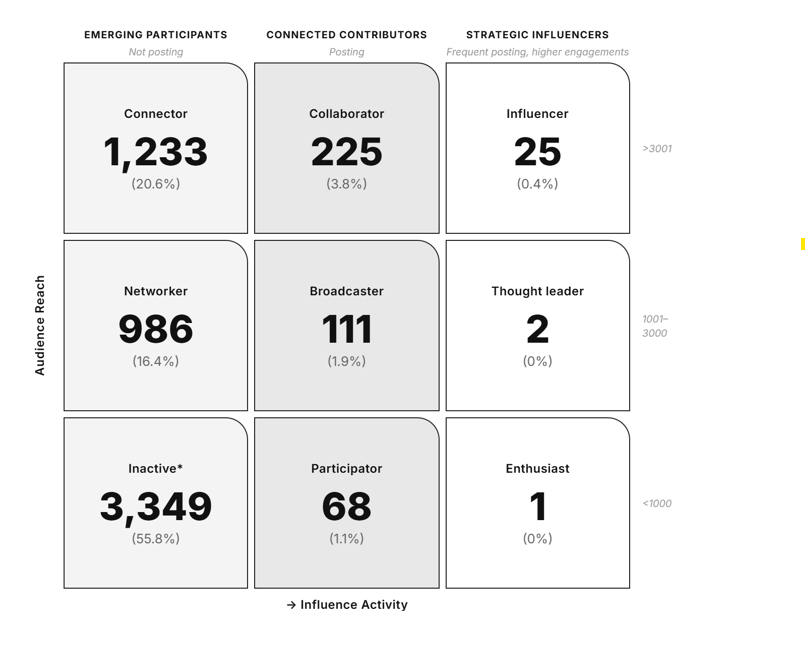
The data from this assessment shapes everything that follows. It determines your training pathways, your content needs, and your realistic timeline for results.
Step two: establish cross-functional governance
Social selling touches multiple functions: sales, marketing, communications, HR, legal, and compliance. Without clear governance, you'll face turf wars, inconsistent messaging, and slow approvals that frustrate sellers.
Create a steering committee with representatives from each function. Define roles clearly.
-
Marketing owns content creation and brand guidelines.
-
Sales owns LinkedIn Sales Navigator adoption and usage.
-
Communications handles crisis scenarios.
-
Legal signs off on what can and cannot be shared.
This governance structure prevents the programme from stalling when questions arise about approvals, brand voice, or competitive intelligence.
Step three: design role-based training pathways
Different roles need different capabilities. A Business Development Representative needs to excel at prospecting and connection requests. An Account Executive needs to nurture existing relationships and engage buying committees. A Sales Leader needs to model the behaviour and build their own thought leadership presence.
Design training pathways that match these distinct needs. Avoid the temptation to create one generic programme for everyone. Role-specific training feels more relevant and drives higher completion rates.
Tribal Impact's social selling enablement programmes include practical workshops, ongoing coaching, and on-demand learning modules through the MyTribe Academy platform. This blended approach caters to different learning styles and schedules.
Step four: align content to the buyer journey
Sellers won't post if they don't have anything worth posting. Content is the fuel for social selling, and most programmes underestimate how much content they need.
Map content to each stage of the buyer journey. Early stage content addresses industry challenges and sparks curiosity. Mid-stage content demonstrates your approach and shares proof points. Late-stage content handles objections and builds confidence in the decision.
Make content easy to share. Pre-written posts with suggested commentary save sellers time. At the same time, encourage sellers to add their own perspective. Posts with a human voice outperform anything that looks templated.
Step five: integrate Sales Navigator into daily workflows
LinkedIn Sales Navigator is the primary tool for enterprise social selling. Tool adoption alone doesn't create results. You need to embed Sales Navigator into existing sales rhythms so that using it becomes automatic.
According to a Forrester study commissioned by LinkedIn, organisations using Sales Navigator effectively saw a 312% three-year return on investment. The gains came from access to higher-quality leads, more efficient prospecting, and stronger relationship-building.
Build Sales Navigator into weekly deal reviews. Have sellers share insights they've gathered about accounts. Review saved leads and accounts together. Make the tool visible in team conversations rather than something people use in isolation.
How to measure social selling at enterprise scale
Leading indicators that predict success
Leading indicators tell you whether behaviours are happening. They're the early signals that your programme is on track before commercial results appear. Track these weekly or monthly.
Profile completeness and optimisation scores show whether sellers have built a credible presence. Connection growth with target accounts indicates expanding reach. Content engagement rates reveal whether posts are resonating. InMail response rates demonstrate prospect receptivity.
The LinkedIn Social Selling Index (now only available to LinkedIn Sales Navigator users) provides a benchmark. Research consistently shows that sellers with higher SSI scores generate more pipeline. SSI is a proxy, not the end goal. Keep it in context.
Lagging indicators that prove commercial impact
Lagging indicators connect social activity to business outcomes. They're what you present to leadership to justify ongoing investment. Track these quarterly.
Pipeline attributed to social touches shows how much of your pipeline originated from or was influenced by LinkedIn activity. Deal velocity compares how fast socially-touched deals move versus others. Win rates highlight whether social engagement correlates with better outcomes. Average deal size reveals whether you're reaching higher-value opportunities.
Tribal Impact's approach to measurement tracks progress in the language of revenue rather than reach. This commercial framing makes it easier to secure ongoing budget.
Building an attribution model
Attribution in social selling is imperfect. You won't capture every influence point. You can still build a model that gives directional confidence and measures Trust Movement.
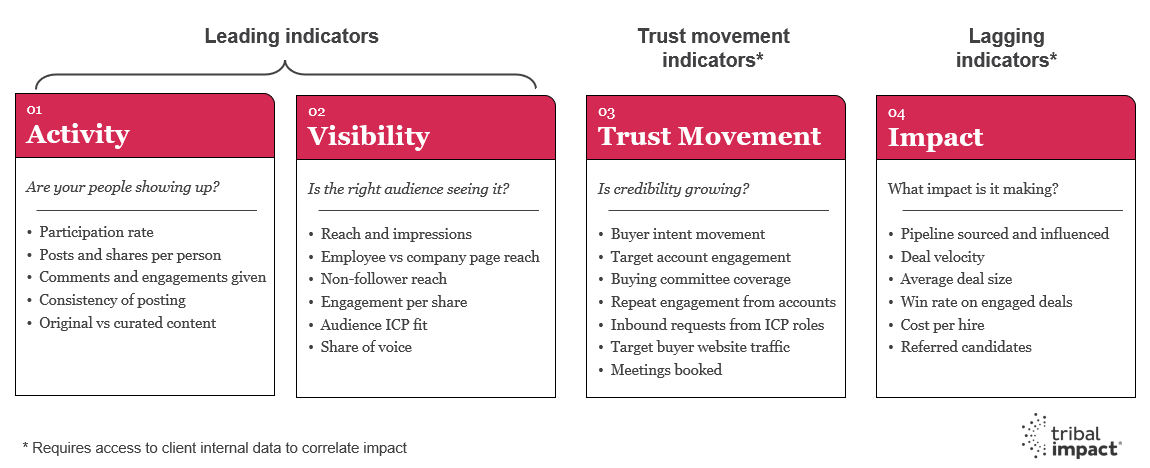
Start by defining what counts as a social touch. A connection request accepted, a content engagement, a profile view from a target account, or a conversation in direct messages could all qualify. Then work backwards from closed deals to identify which had social touches in their history.
Use conservative attribution at first. If social was one of many touches, give it partial credit. Over time, you'll build enough data to see patterns and refine your model.
How to align sales and marketing around social selling
The content collaboration challenge
Marketing creates content. Sales needs content. Yet the handoff often breaks down. Marketing produces assets that feel too branded. Sales wants material that sounds more personal and demonstrates their understanding of the wider market. Neither side is wrong, but the gap creates friction.
Bridge this by involving sellers and experts in content planning. Ask them what questions prospects are asking. Have them share the objections they hear. Use these inputs to create content that addresses real conversations.
Then make content accessible. Build a simple, searchable content hub or use an employee advocacy tool where sellers can grab what they need in seconds.
Shared goals and joint accountability
If sales owns adoption and marketing owns content, neither feels fully accountable for results. Shift to shared goals that both functions own together.
A shared pipeline target influenced by social activity creates joint accountability. Marketing can't claim victory from content views if sellers aren't converting them. Sales can't blame content quality if they're not using what's available. Both sides need each other to succeed.
Hold joint reviews where sales and marketing examine social selling performance together. Celebrate wins as a combined team.
How to sustain adoption over time
Why most programmes lose momentum
The pattern is predictable. Excitement peaks during the launch. Early adopters show impressive results. Then competing priorities take over, new hires don't get trained, and the programme quietly fades into the background.
Programmes fail to sustain because they lack ongoing enablement. A one-off training creates a spike in activity followed by a gradual decline. Sellers need regular reinforcement, coaching, and fresh content to maintain momentum.
Building habits that stick
Behaviour change requires more than knowledge transfer. People need to practice new skills until they become automatic. Design your programme with this in mind.
Start small. Ask sellers to commit to one action per day: a connection request, a comment on a prospect's post, or sharing a piece of content. Small wins build confidence. Confidence leads to more activity.
Create social proof. When sellers see peers succeeding, they're more likely to try it themselves. Share success stories regularly. Feature top performers in team meetings. Make social selling visible.
Tribal Impact's enablement model emphasises coaching and ongoing support rather than one-off training events. This approach recognises that sustainable behaviour change takes time and reinforcement.
Training your internal champions
You can't coach thousands of sellers yourself. Build a network of internal champions who can carry the message forward.
Look for sellers who are already active on LinkedIn and enthusiastic about social selling. They'll have credibility with their peers. Train them to become local advocates who can answer questions, share tips, and model best practices.
Give champions the tools they need: talking points, success data, objection handlers. Meet with them regularly to share updates and gather feedback from the field.
How to activate sales leadership on LinkedIn
Why executive presence matters
When sales leaders are visible on LinkedIn, it signals to the entire team that social selling matters. If leadership stays silent, sellers will assume it's optional.
Beyond internal signalling, executive presence influences buyers directly. Research from FTI Consulting found that 92% of professionals are more likely to trust a company whose senior executives are active on social media. When prospects see your leaders sharing insights, it builds organisational credibility.
Making it easy for busy executives
Executives have limited time. They won't become daily content creators but they can still be visible with the right support.
Tribal Impact's executive branding programmes start with understanding each leader's unique perspective and voice. Then a content specialist develops posts that capture that voice authentically, requiring minimal time from the executive.
Consistency beats volume. Even one thoughtful post per week keeps a leader visible. The goal is to build a consistent presence that they can feel confident enough to continue themselves with little or no support.
How to handle common objections from sellers
"I don't have time"
This is the most common objection, and it's legitimate. Sellers have quotas to hit and endless demands on their time.
Counter it with efficiency data. Social selling done well takes fifteen to twenty minutes per day. That investment pays back through warmer conversations and shorter sales cycles. Show sellers the time saved downstream.
Also, remove obstacles. If posting content requires five clicks and an approval chain, nobody will do it. Simplify the process so social selling fits into existing workflows.
"I'm not sure what to post"
Many sellers freeze when faced with a blank posting screen. They worry about saying something wrong or sounding too salesy.
Remove the blank page. Give sellers a content library with ready-to-share posts. Offer conversation starters like commenting prompts and engagement templates. Provide examples of what good looks like from peers in similar roles.
Reassure them that authenticity matters more than perfection. A post with a minor typo but genuine insight will outperform polished corporate speak every time.
"I don't see how this helps me hit quota"
Connect social selling directly to pipeline. Share data from your organisation showing the correlation between social activity and commercial outcomes. This case study shows exactly how it can connect and work.
Better yet, show them deals their peers have influenced through LinkedIn. Real examples from within the company carry more weight than external statistics.
How to adapt your programme for global teams
Regional considerations
A programme designed for North America won't work identically in Europe, Asia-Pacific, or Latin America. Cultural norms around networking, content sharing, and professional self-promotion vary by region.
Involve regional leaders in programme design. They understand local nuances that headquarters may miss. Allow flexibility in execution while maintaining consistency in outcomes.
Translate materials properly, not just linguistically but culturally. A phrase that resonates in one market may fall flat or offend in another.
Managing across time zones
Global teams can't all attend the same live training session. Build your programme with asynchronous learning in mind.
On-demand modules let sellers learn when it fits their schedule. Recorded coaching sessions can be watched at convenient times. Regional cohorts can meet within compatible time zones.
Balance global consistency with local autonomy. Set the standards centrally, but trust regional leaders to implement in ways that work for their teams.
How AI fits into enterprise social selling
Where AI helps
AI can accelerate content creation, suggest engagement opportunities, and analyse what's working. Tools can draft initial posts, identify trending topics, and recommend optimal posting times.
For time-pressed sellers, AI assistance removes friction from the posting process. It can turn rough ideas into polished drafts in seconds.
Where human credibility still wins
AI can help, but it can't replace human credibility. Buyers connect with people, not algorithms. A post that sounds authentically human will always outperform generic AI-generated content.
The goal is human credibility at sale, not human replacement. Use AI to handle the mechanics. Let sellers add the perspective, stories, and voice that make content connect.
Tribal Impact's approach to AI in social selling focuses on helping employees show up consistently while keeping the human voice central.
In conclusion: Build now for 2027
Scaling LinkedIn social selling across global enterprise teams isn't a quick win. It requires alignment across functions, commitment from leadership, and patience to build new habits.
The investment is worth it. When done well, social selling helps you reach buyers earlier, build trust faster, and close deals more efficiently. The commercial impact shows up in pipeline velocity, deal size, and win rates.
If you want 2027 to look different, the work has to begin before the year starts. Assess where your team stands today. Build governance that prevents delays and confusion. Design training that meets sellers where they are. Measure what matters in commercial terms. Sustain the effort through ongoing enablement and visible leadership support.
If you're ready to build a social selling programme that connects your sales team's LinkedIn presence to measurable commercial outcomes, learn how Tribal Impact can help.
Frequently asked questions
What is the LinkedIn Social Selling Index and why does it matter?
The LinkedIn Social Selling Index (SSI) measures how effectively you use LinkedIn for social selling across four pillars: establishing your professional brand, finding the right people, engaging with insights, and building relationships. Tribal Impact uses SSI alongside other metrics to benchmark teams and track improvement over time.
How long does it take to see results from enterprise social selling?
Most programmes see initial behavioural indicators improve within the first thirty to sixty days. Commercial impact typically becomes visible within three to six months as socially-touched deals move through the pipeline. Tribal Impact designs programmes with clear milestones so you can demonstrate progress to stakeholders along the way.
How do you get sellers to adopt social selling?
Adoption comes from making it easy, showing quick wins, and building peer pressure through visible success. Remove friction from posting. Start with small daily actions. Share stories of colleagues succeeding. Tribal Impact's enablement approach emphasises sustainable behaviour change rather than one-off training.
What content should sellers share on LinkedIn?
Sellers should share content that helps their prospects solve problems or think differently about challenges. This includes industry insights, customer success stories, practical tips, and their own perspectives on market trends. Tribal Impact helps organisations build content libraries mapped to the buyer journey.
How do you measure ROI from LinkedIn social selling?
Track both leading indicators like engagement and connection growth, and lagging indicators like pipeline influenced by social touches. Build an attribution model that connects LinkedIn activity to commercial outcomes. Tribal Impact's measurement frameworks track progress in the language of revenue to secure ongoing investment.
Can social selling work alongside traditional sales methods?
Social selling enhances rather than replaces traditional methods. It warms up cold outreach, shortens sales cycles, and keeps you visible between formal touchpoints. The most effective sales teams blend social engagement with phone, email, and in-person conversations.