.png?width=200&height=92&name=Tribal%20Logo%20Dark%20Grey%20(1).png)
When I talk to business leaders about LinkedIn strategies, one question keeps coming up: “Does executive LinkedIn presence really drive sales?”
It’s a fair question. We’ve all seen leadership posts on social media that feel “nice to have” rather than business critical. But when leadership presence connects directly to pipeline, it stops being a branding exercise and becomes a growth strategy.
Recent research from FTI Consulting found that 92% of professionals say they are more likely to trust a company whose senior executives are on social media, and FTSE 100 companies with at least four active executive leaders on LinkedIn see a 38% higher digital impact. (FTI Consulting, Leading from the Front)
In other words, when leaders show up online, stakeholders notice and respond. The opportunity is there and senior decision-makers are already paying attention. The question is how to turn that visibility into pipeline, not just impressions and profile views.
That’s what I explored in my LinkedIn Live with Purna Virji, Principal Consultant at LinkedIn. We looked at how high-growth startup founders use LinkedIn to sell and how enterprise leaders can apply the same habits to build an authentic presence supports complex B2B sales.
What can enterprise leaders learn from startup founders on LinkedIn?
Purna’s latest project which she co-authored with Ruby James, LinkedIn’s playbook “Founder-Led Sales and Marketing Never Ends”, began with a simple observation: founders who show up on LinkedIn grow their companies faster.
“They were building in public,” Purna explained. “The founders who were actively present on LinkedIn and building were growing at a way faster speed than those who just led with the brand or the product. At the end of the day, people connect more with people than brands.”
The data in the playbook backs this up. Start-ups whose founders post at least ten times a year generate 33% more leads and deals close 22% faster when buyers feel they ‘know you’.

This principle scales into large organisations. When executives show up with authenticity, they humanise the business and create a halo effect for the brand. I’ve seen it with our clients' many times. When a C-level leader shares their perspective, they open doors to other senior leaders that no sales outreach could. Their credibility is what converts.
Why does executive LinkedIn activity build so much trust with B2B buyers?
Trust was a theme that came up repeatedly during our conversation and is something that runs through the core of our work here at Tribal Impact.“In B2B, it’s very different from B2C,” Purna explained. “When you’re making decisions with company budget, it’s high visibility and a little bit of career security on the line. That’s why trust and credibility matter so much. When people understand how leaders think, it builds that sense of pre-trust, by the time they get to the demo, they already feel they know you.”
That’s exactly why at Tribal, we aim to start every employee advocacy or social selling programme with leadership activation. Executives set the tone. They show that the company’s people aren’t hiding behind the logo and, by going first, they quietly give others permission to show up too.
And when leaders post, people listen. Buyers are not only evaluating the offering. They are watching the people behind it and deciding if they trust them with their budget.
Credibility builds trust, and trust drives growth.
What evidence is there that executive LinkedIn presence drives measurable sales results?
If you want proof that executive visibility affects the bottom line, just look at the Sendoso case study in the playbook. Their leaders saw an 11% higher win rate when prospects were exposed to their posts, and a 120% higher closed-won deal size when those prospects followed them on LinkedIn.
Purna also shared the example of Irina Novoselsky, CEO of Hootsuite.
“Irina didn’t just show up once a month and disappear,” she said. “She’s consistent, she understands her audience, and she shares content that gives value. She’s transparent about the impact too. Thirty-seven percent of Hootsuite’s monthly leads are influenced by her social presence.”
We see the same pattern when we activate leaders and salespeople together. In our recent social selling programme with a global enterprise software company, we started by coaching executives and sales leaders to lead from the front on LinkedIn, then enabled AEs and BDRs to build social selling habits around real opportunities.
The commercial impact was clear:
- Sellers who maintained a LinkedIn SSI score above 60 had 26% higher pipeline
- Average deal size grew by 13%
- Reply rates from warm outreach were 24% higher
- The programme contributed to more than 40 opportunities
On the leadership side, we saw a 37% increase in leader post engagement and 15% more C suite connections in their top 100 accounts, with several seven figure opportunities influenced by executive visibility.
We have seen similar results in other executive activation work at Tribal Impact. When leadership voices are active and strategic, they influence both perception and pipeline.
This reflects what our CEO Sarah Goodall argues in her Forbes article “Why Executive LinkedIn Presence Is Essential To Sales Success”. In an environment of longer sales cycles and highly informed buyers, executive visibility is not a vanity project. It is a way to create earlier, warmer and more human connection with decision makers so sales teams are not starting from a cold, transactional place.
These results do not happen by accident. They come from consistency. The leaders who treat LinkedIn as part of their growth strategy, not an afterthought, are the ones who see measurable commercial outcomes.
How personal should executives be on LinkedIn?
One of the most common questions I get from executives is how personal they should be. No one wants to overshare, but I thought Purna’s answer offered perfect advice.“You don’t have to share wounds, share the scar tissue,” she said. “Talk about the mistakes you made once you’ve learned from them. No one’s perfect, and people connect with honesty.”
Vulnerability doesn’t have to mean emotional storytelling, it can be as simple as sharing a lesson learned, a challenge overcome, or pride in a team achievement. The goal is to show how you think, not just what you know.
How consistent do executives need to be on LinkedIn to see real results?
Another question I hear a lot is about consistency. How often do I need to post? What if I run out of ideas? What if no one engages?
One of the things I see most often in our programmes is how momentum builds once leaders commit to posting. The first few weeks can feel uncomfortable, the ideas come slowly, engagement feels uncertain, but then something shifts. A few comments turn into conversations, and those conversations start to spark new ideas. That’s when consistency really starts to pay off.
When I asked Purna how leaders can stay consistent, she cut straight to the reality of it.
“Most people give up before the first 90 days and that's why they fail to see traction. But it really takes doing this consistently over time. Just like brand building with an actual brand, this is your personal brand.”
At Tribal Impact we see the effect of this consistency in the data that we collect to spot patterns. As C-suite and senior leaders become more visible and active, employee activity starts to climb as well. More people post, more conversations happen and the overall online presence of the company strengthens.
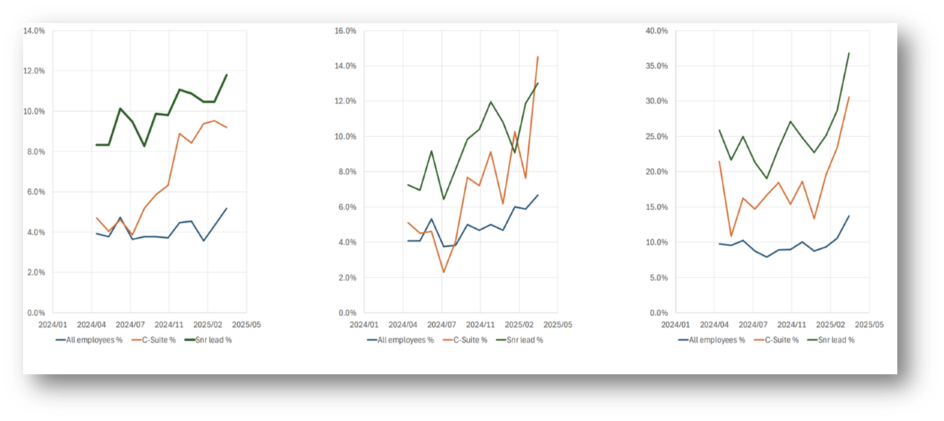
The reverse is also true. When leadership activity drops, employee posting often tail off over the following months.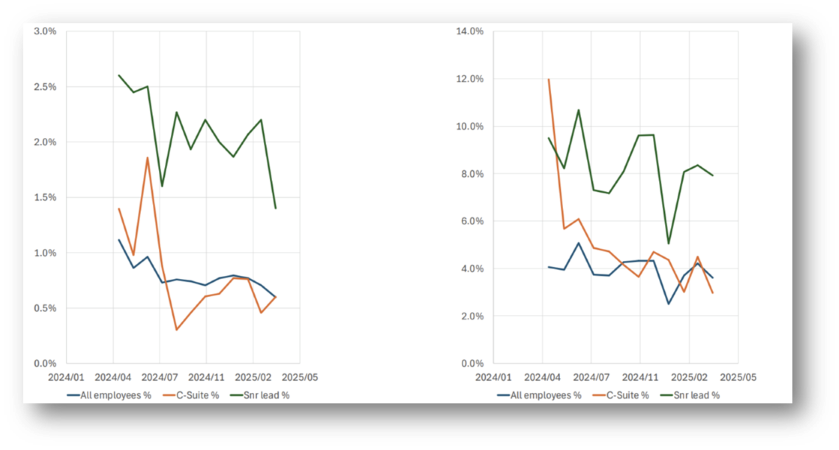
Leaders are not only driving external perception, they are setting the pace internally. When they show up regularly, they quietly give employees permission to do the same, which strengthens advocacy and social selling across the organisation and supports trust both inside and outside the business.
How can busy executives get started on LinkedIn without feeling overwhelmed?
To wrap up our session, I asked Purna what advice she’d give to anyone starting out, she shared, “When people are getting started, I show them it doesn’t have to be time-consuming or overwhelming. I call it five steps in five minutes. First, what do people often come to you for advice on? Second, what’s your preferred content format? Third, choose one angle to focus on. Fourth, decide when you’ll record or post it. Fifth, identify three people who are likely to engage with it. That’s your blueprint.”
Her words reminded me of a line from our recent LinkedIn Live with Pfizer’s team: “Just do it.” The first post might not change your world, but it’s a start. Every post helps you learn, build confidence and grow your influence.
As Purna writes in the playbook, “Every success story has a Day One. Day One might suck. But do it anyway. Three months of discomfort can earn you a decade of authority.”
That’s what leadership on LinkedIn is all about, showing up, sharing your perspective, and building trust over time. Because when executives speak, people listen. And when that happens, leadership online presence starts to drive real commercial value.
Further reading
If you would like to go deeper into the research and examples behind this conversation, here are some useful links.
- Founder Led Sales and Marketing Never Ends by LinkedIn and Scale Venture Partners. The playbook that inspired this conversation with Purna, including data on how consistent founder posting drives more leads and faster deals.
- Beyond the CEO. The power of leadership voices on social media by FTI Consulting, part of the Leading from the Front research. A detailed look at how visible executive teams outperform on digital impact and trust.
- Stronger sales performance with Social Selling by Tribal Impact. Our case study on how activating leaders and salespeople at a global IT company together drove higher pipeline, deal size and reply rates for a global software company.
- Why Executive LinkedIn Presence Is Essential To Sales Success by Sarah Goodall on Forbes. A deeper exploration of why executive visibility matters so much in today’s longer, more complex B2B sales cycles.