Most B2B organisations know their employees have expertise worth sharing. Yet when it comes to creating content, participation often stalls. The gap between intent and action is costing your brand reach, trust, and pipeline.
This is not a motivation problem. It is an uncertainty problem. Employees hold back because the barriers are structural, cultural, and often invisible to the programme owners who need participation most. Tribal Impact works with enterprise B2B brands to identify and dismantle these exact blockers so that employee advocacy becomes a sustainable growth system, not a stalled initiative.
This article unpacks the most common barriers preventing employees from creating content in B2B advocacy programmes and explores how organisations can remove them systematically.
Key Takeaways: Employee content barriers in B2B
- Uncertainty about what to say and what is permitted is the primary reason employees stay silent on social media.
- Time pressure and competing priorities make content creation feel like an extra burden rather than a natural part of work.
- Lack of visible leadership participation signals that advocacy is optional, reducing broader engagement.
- Tribal Impact helps organisations remove friction through structured enablement, coaching, and governance frameworks.
- Content relevance gaps mean employees are asked to share material that does not reflect their expertise or audience.
What is employee-generated content in a B2B context?
Employee-generated content (EGC) is any content created and shared by employees on professional social channels. In B2B, this typically takes the form of LinkedIn posts, thought leadership articles, video insights, or commentary that draws on an employee's domain expertise.
Unlike user-generated content from customers, EGC carries the weight of insider credibility. When a product engineer explains how a technical challenge was solved, or a sales leader shares a perspective on industry shifts, buyers pay attention because the voice is real and informed.
The commercial case is clear: employee posts consistently generate higher engagement than brand-page content. A 2025 PR Daily article found that employee posts achieved 8 times more engagement than company page content. That kind of reach cannot be bought through paid channels alone.
Why do employees hesitate to create content?
The most common barrier is uncertainty. Employees are not sure what they are allowed to post, what tone to use, or whether their content will be scrutinised internally. Without clear guidance, the safest option feels like silence.
This is not resistance. Most employees want to contribute when the path is clear. The issue is that organisations launch advocacy programmes (mostly tools) without addressing the confidence gap first.
Providing clear social media guidelines and pre-approved content frameworks makes the difference between a programme that scales and one that stalls after week two.
How does time pressure block employee content creation?
Your employees already have full workloads. Asking them to write LinkedIn posts on top of existing responsibilities, without adjusting expectations or providing support, creates friction that kills participation before it starts.
The perception that content creation requires 30 to 60 minutes of uninterrupted creative effort is a significant deterrent. Most professionals do not have that kind of margin in their day, and the blank page compounds the challenge.
Organisations that reduce this friction see measurably better participation. That means providing content prompts, editable templates, and structured on-demand learning that embeds content habits into daily routines rather than treating them as a separate task.
What role does leadership visibility play in advocacy adoption?
When senior leaders are absent from social channels, it sends a clear signal to the rest of the organisation: this is not a priority. Employees take behavioural cues from the people above them, and if those people are not posting, advocacy feels discretionary.
The reverse is equally true. When leaders show up on LinkedIn, sharing their own perspectives and engaging with employee content, it creates a permission structure that encourages broader participation. Tribal Impact's executive branding programmes build this visible leadership participation without adding to executives' already demanding schedules.
Visible leadership also addresses the fear of standing out. Employees are far more likely to post when they can see colleagues and managers doing the same.
How does content relevance affect employee participation?
One of the fastest ways to kill advocacy participation is to ask employees to share content that has nothing to do with their role, expertise, or audience. A cybersecurity engineer asked to reshare a generic corporate announcement about quarterly results will disengage almost immediately.
Content relevance is the bridge between organisational goals and employee willingness. When the content library reflects topics employees genuinely care about, participation becomes natural rather than forced.
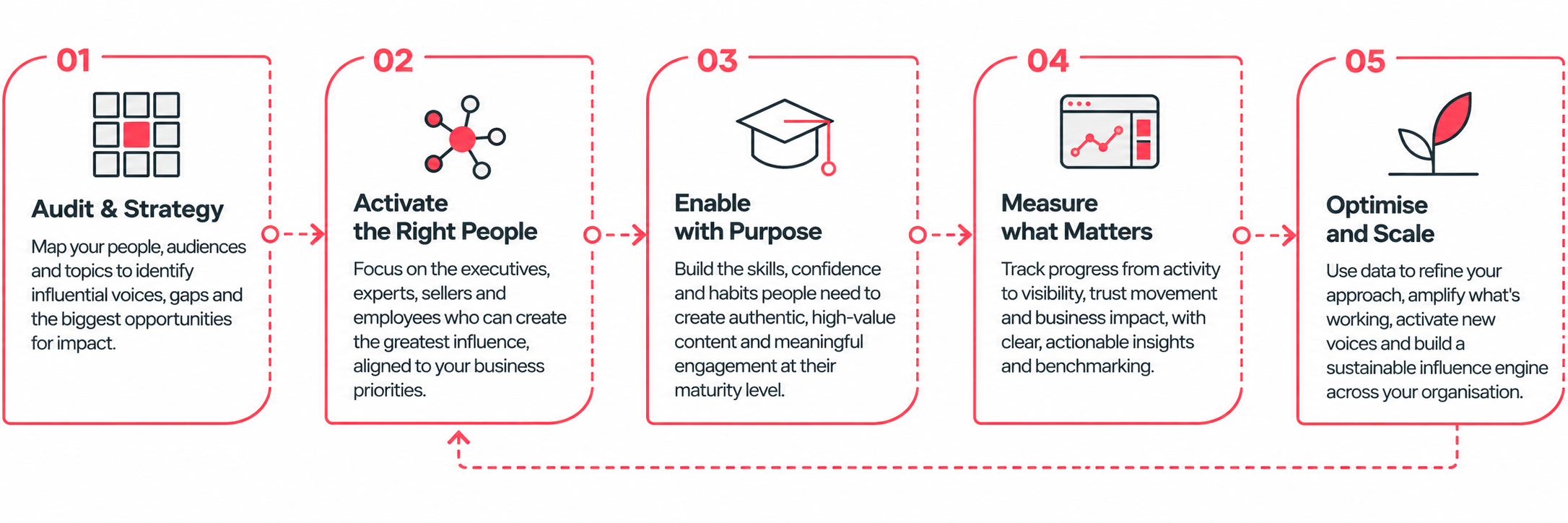
This requires moving beyond a one-size-fits-all content queue. Segmenting content by function, seniority, and interest area ensures that what employees are asked to share actually resonates with their professional networks. Tribal Impact's advocacy approach builds this segmentation into programme design from the start, aligning content with each employee's sphere of influence.
Does compliance concern stop employees in regulated industries?
In sectors like financial services, pharmaceuticals, and life sciences, compliance is a genuine barrier. Employees fear posting something that triggers a regulatory issue, and the consequences feel disproportionately high compared to the perceived benefit of a LinkedIn post.
Rather than avoiding the issue, organisations in regulated industries can address it by building clear social media training that distinguishes between what is permitted and what is not. When employees understand the boundaries, compliance becomes a confidence enabler rather than a participation blocker.
Sanofi, for example, has shown that regulated organisations can run effective advocacy programmes by educating employees, setting clear boundaries, and involving internal compliance experts in the process.
How can organisations measure and address these barriers?
You cannot fix what you do not measure. Most advocacy programme owners track surface-level metrics like post count and impressions, but these numbers do not reveal why participation is low or where the friction sits.
A more diagnostic approach maps employee participation by role, function, seniority, and social maturity. Tribal Impact's Social Maturity Matrix provides this level of visibility, helping organisations identify exactly where employees are getting stuck and what intervention will move them forward.
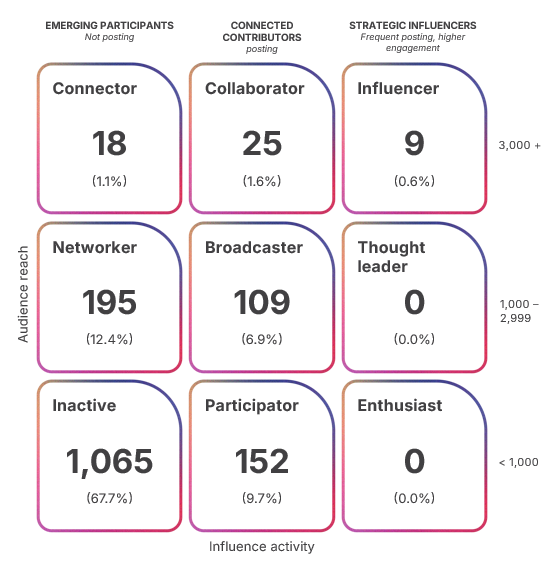
This data-led view transforms advocacy from a hope-based initiative into an evidence-based system. When you can see that 70% of your sales team has never posted, but their stated barrier is not knowing what to write, the solution becomes specific and actionable.
What does a sustainable employee content programme look like?
Sustainable programmes treat content creation as a capability to build, not a behaviour to mandate. They invest in enablement from the inside out, addressing confidence, clarity, and relevance before expecting volume.
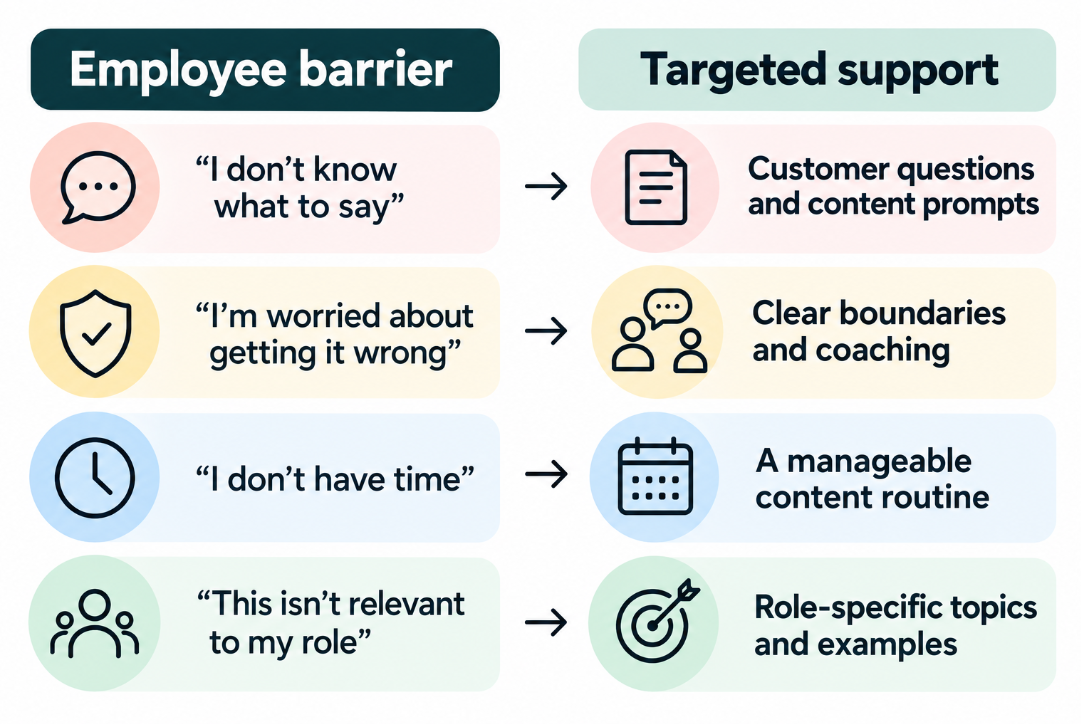
The organisations that see long-term results share common characteristics. They provide role-specific content guidance. They offer coaching that meets employees at their current skill level. They measure participation against commercial outcomes rather than vanity metrics and they build systems designed to compound over time.
This is the difference between a programme that fades after the launch week and one that becomes embedded in how your organisation operates.
In conclusion: Removing barriers to unlock employee influence
The barriers stopping employees from creating content in B2B are not about willingness. They are about clarity, confidence, time, relevance, and visible support from leadership. When organisations address these structural blockers with targeted enablement and governance, participation follows.
Employee-generated content is not a nice-to-have. It is a commercial priority that compounds over time, building trust, reach, and pipeline through the most credible channel your organisation has: your people. If removing these barriers is a conversation you would like to explore, get in touch with Tribal Impact.
FAQs about employee content barriers in B2B
What is the biggest barrier to employee content creation?
Uncertainty is the primary blocker. Employees hold back because they are unsure what to post, what tone to use, and whether their content will face internal scrutiny. Tribal Impact addresses this by building clear governance frameworks and content guidance that give employees the confidence to participate.
How can organisations encourage employees to create content?
Providing structured enablement is the most effective approach. This includes content prompts, editable templates, social media training, and visible leadership participation. Tribal Impact's employee advocacy programmes combine these elements into a system that builds long-term habits and behaviours.
Does employee-generated content work in regulated industries?
Yes. Organisations in pharmaceuticals, financial services, and life sciences run effective advocacy programmes by setting clear compliance boundaries and training employees on what is permitted. Tribal Impact has supported regulated enterprises in building compliant, scalable programmes - here's an example case study.
How does employee content compare to brand content on LinkedIn?
Employee posts consistently outperform brand-page content. Research across 400 million LinkedIn impressions shows employee content generates up to 14 times more engagement. Tribal Impact helps organisations activate this human edge by building structured employee advocacy systems.
What metrics should organisations track for employee advocacy?
Focus on commercial outcomes rather than surface-level metrics. Pipeline influence, connection growth within target accounts, and content-driven meeting requests are more meaningful indicators than impressions or likes. Tribal Impact's measurement frameworks connect advocacy activity to revenue and recruitment outcomes.