.png?width=200&height=92&name=Tribal%20Logo%20Dark%20Grey%20(1).png)
When I first started talking to new customers about employee advocacy, one of the biggest challenges I saw wasn’t whether they believed in the value, it was whether they could get the rest of their business to believe in it too.
Marketing leaders get it. They know the reach, credibility and influence of their employees can go so much further than their brand page ever will. According to LinkedIn, only 3% of employees share company content, yet they generate 30% of the total engagement. That stat alone shows just how much opportunity is being left on the table.
That’s where I come in. I’m Aly Grenyer, Sales Specialist at Tribal, and I work closely with CMOs and senior marketing leaders to help them build the case for investing in an employee advocacy program.
In the early stages, I guide them through a consultative process to figure out what a realistic budget looks like for their organisation. We use our Scaling Social Framework (below) to assess where they are today in terms of employee and executive LinkedIn activity across sales, leadership and subject matter experts, and where they want to be in future.
If you're looking to get budget buy-in for your employee advocacy program, read on as I break down our budget planning approach.
Step 1: Benchmark your business against competitors
Auditing your current LinkedIn activity and looking at what your competitors are doing is a really powerful first step. Use LinkedIn to check how active employees are across your organisation, are they posting, commenting, resharing? Then do the same for three or four of your closest competitors.
You can also use Sales Navigator to dig a bit deeper. Filter by geography or department, and check who’s posted in the last 30 days. You’ll probably notice that the activity isn’t evenly spread. Some groups, like sales or marketing, may be more active than leadership. Or you might find very few people are posting at all.
Sometimes I only need to share one number to spark a lightbulb moment. I remember one conversation where I showed a team that only 3% of their company was posting, and just 1% of their C-suite had shared anything. Their competitors were miles ahead, and that was the moment they realised they needed to do something about it.
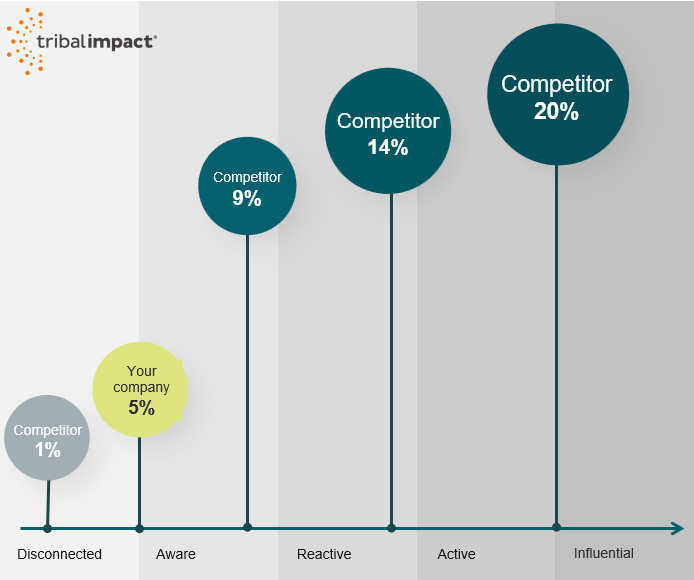
Illustrative Employee LinkedIn Benchmarking Report
Even if it’s not what you hoped to see, this is useful insight. You don’t need anything fancy, just a few key stats or even screenshots can make the case. And if you’re talking to stakeholders who love data, this approach really resonates.
Step 2: Map where your people are on the maturity scale
Once you’ve got an external view, it helps to zoom in and look at where your own teams are in terms of social activity so you can identify your maturity gap. Who’s already active? Where are the gaps? You could break this down by region, function or role type.
I tend to look at sales, executives and subject matter experts, and quite often, the levels of activity are lower than people expect. Mapping this to our Social Media Maturity Matrix can help show where people are today and where you’d like them to be. You don’t need a complicated model. A basic scale like inactive, beginner, confident and advanced works well.
The maturity gap between teams or compared to competitors can highlight just how much opportunity there is, or how much ground there is to make up. This ultimately helps as an indication of how much budget you will need.
Start thinking about what kind of training or support might help move the needle. Different groups will need different things, your C-suite might need short, focused coaching, while your sales teams may benefit from something more hands-on.
And it’s worth remembering that this kind of enablement can directly impact revenue. LinkedIn data shows that social sellers create 50% more pipeline, close deals that are 15% larger, and generate 38% more opportunities.
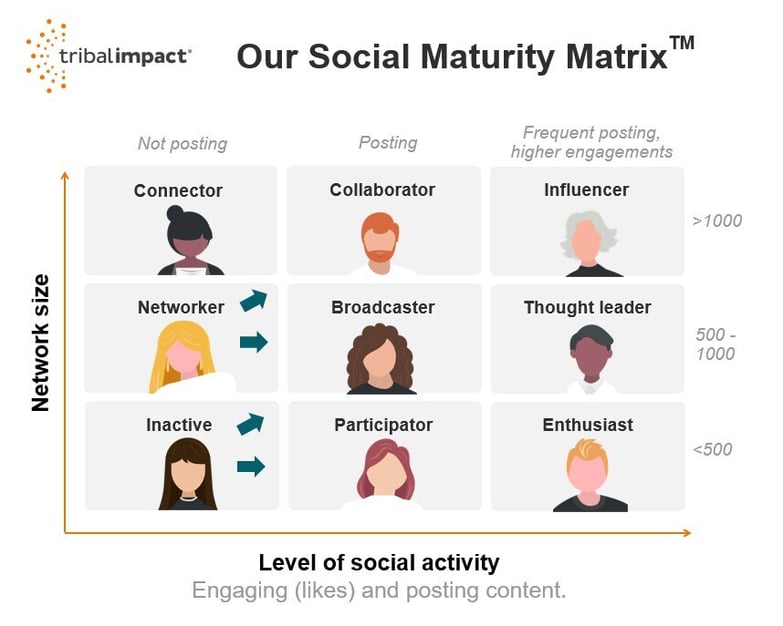 Tribal Impact's Social Maturity Matrix.
Step 3: Choose your strategic activation path
Now that you’ve got a clearer picture, the final step is to sketch out what kind of employee advocacy program could work for your organisation and scope your enablement plan. You don’t need to go all in at once. In fact, I usually suggest starting small – one team, one business unit, one region.
Then think about what support they’d need to become more active. Would LinkedIn training help? Do they need content ideas or guidelines? Would it be useful to pair more experienced content creators with those just starting out? This is where our social selling framework comes in handy (graphic below).
I use our Scaling Social Framework to help frame this (see graphic below). It helps me advise whether to focus strategically on a single stakeholder group, like sales or executives, to show quick results, or to choose to scale holistically, activating multiple groups at once to maximise momentum and create economies of scale. In more mature industries or competitive spaces, the latter can really help accelerate impact.
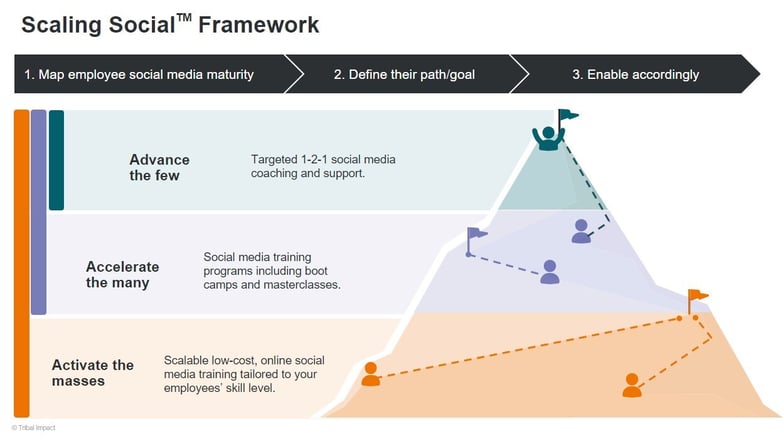
Tribal Impact’s Scaling Social Framework helps tailor LinkedIn training globally
The benefit of scoping multiple teams together is that it can lead to efficiencies. Shared training reduces cost per head, aligned messaging builds brand consistency, and cross-functional activity builds credibility across your market.
Ultimately, your employee advocacy program should reflect your ambition – whether that’s to catch up, differentiate or lead in your space.
Step 4: Align your budget with business impact
In my experience, the organisations that secure budget quickly are the ones that present a clear picture: what the problem is, how they compare to others, and what a realistic solution looks like. That’s what the first three steps are all about.
You start with data that highlights your maturity gap. You map where your sales, executives, and subject matter experts sit today. Then you scope a training plan aligned to your activation ambition, whether that’s to catch up, differentiate, or lead. It gives stakeholders something concrete to say yes to.
Activating multiple stakeholder groups together can accelerate your return on investment. Shared training reduces per-head costs, coordinated storytelling builds brand visibility, and cross-functional activity boosts your reach, credibility and competitive edge.
When I’m helping clients scope a program, I always look at their digital maturity, their industry competitiveness, and their internal engagement. The more connected your internal teams are, the greater the momentum and the more efficient your spend.
It also helps open other conversations. If your CEO isn’t active on LinkedIn, for example, they’re missing a huge opportunity. According to Sprout Social, 70% of consumers feel more connected to brands with CEOs that are active on social media.
Still not sure where to begin?
Getting budget buy-in for your employee advocacy program doesn’t need to be complicated. Start with the data, keep it relevant, and focus on what matters to your stakeholders.
Your budget should reflect where you are today, how competitive your market is, and how ambitious you want to be.
If you’ve got questions or just want to talk it through, feel free to drop me a message on LinkedIn. I’m always happy to talk data!