.png?width=200&height=92&name=Tribal%20Logo%20Dark%20Grey%20(1).png)
Measuring social selling and employee advocacy well means tracking four stages in order: Activity, Visibility, Trust Movement and Business Impact. Most programmes measure the first, reach the second, then jump straight to claiming the fourth. The stage they skip, Trust Movement, is the evidence that turns marketing activity into something a finance director will understand.
That is the short version. Here is why it holds up, and how to put it to work.
Key takeaways: How to prove employee advocacy ROI to finance
- Programmes get stuck at budget time because they can only speak their own functional language.
- A four-stage model (Activity, Visibility, Trust Movement, Business Impact) translates that language into what finance funds.
- Trust Movement is the missing middle: proof that visibility is reaching the accounts the business chose.
- Marketing influences opportunities. It does not own revenue, so the claims have to shrink as control falls.
- Trust Movement only becomes measurable when the programme is built around a strategic target.
Every functional programme I have seen get stuck has been stuck for the same reason. Advocacy, executive visibility, digital selling: the programme runs, the dashboard fills, and the budget conversation stalls, because the programme can only speak in its own functional language. This crosses every industry we work in. It is a functional problem, and it has a structural fix.
The fix is a measurement model with four stages: Activity, Visibility, Trust Movement, Business Impact.
-
Activity asks whether people are showing up.
-
Visibility asks whether what they share resonates.
-
Trust Movement asks whether that resonance is reaching the audiences the business chose.
-
Business Impact asks what it produced.
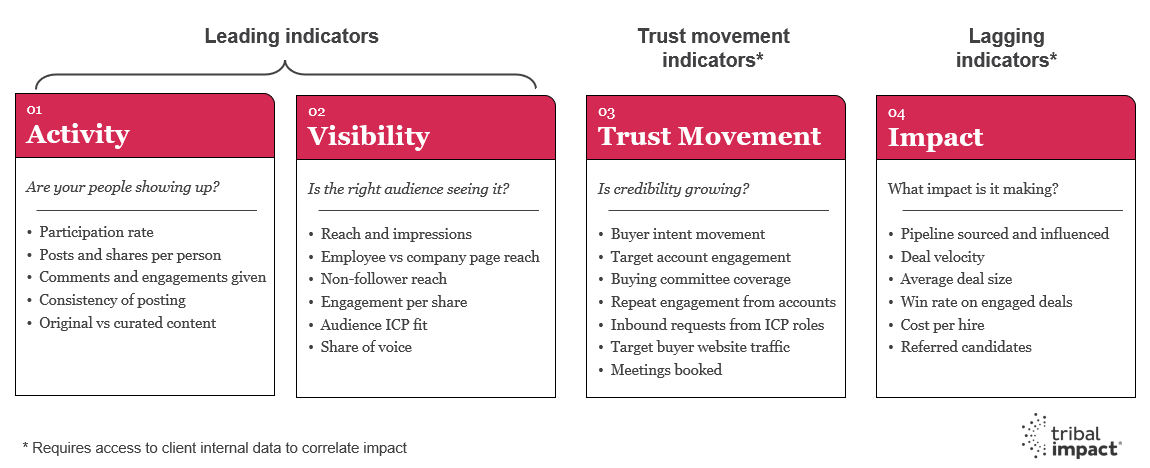
Most programmes measure the first stage, some reach the second, and nearly all then leap straight to claiming the fourth. The stage in between is the one this article exists to define, because it is the piece nobody tallies, and it is precisely the evidence a bigger audience and a more senior budget holder need to see.
What is Trust Movement?
Trust Movement is the set of metrics that sit between the leading indicators and the lagging ones: the evidence that your visibility is turning into commercial relationships and business impact with the accounts and audiences you set out to win.
The way I hold it in my head is simpler still. Activity and visibility tell you the programme is on the right path. Trust Movement tells you the path is leading somewhere.
The signals that count as evidence:
- Buyer intent shifting on the accounts you target, visible in LinkedIn Sales Navigator.
- Relationship intent moving on those same accounts. Inbound enquiries arriving from the accounts you chose rather than from anywhere.
- Meetings booked with the clients you have been targeting.
- Senior connections growing inside those accounts.
- For a talent goal, career-site traffic, measured from the demographic audiences you are trying to attract rather than as a raw number.
You will notice every signal shares a word: target.
Trust Movement only works when the programme is centred on a strategic goal, because movement is only measurable relative to a destination.
Why so many programmes struggle to measure employee influence
It still surprises me how many organisations run advocacy and influence programmes with no strategic goal attached. They run for brand awareness. Brand is a genuine asset, and awareness alone moves no needle a CFO can see.
This, in my opinion, is why marketing struggles to be taken seriously inside so many organisations. Something a recent Propolis report exposed: 84% of CEOs describe marketing as a support function and only 45% of finance and revenue leaders say marketing can demonstrate its financial impact.
Digital teams talk in impressions, reach, clicks and engagements when the CFO cares about how activity drives business growth or reduces cost. A programme built purely for brand visibility will always get stuck at the same moment: budget renewal, when the numbers on the dashboard answer none of the questions in the room.
Trust Movement is the bridge out. It takes the engagements, the likes and the traffic, and turns them into something the business recognises as progress towards a goal it set.
The boundary: Influence, never ownership
Here is where the model demands discipline, and where we have learnt the hard way alongside our clients. You can contribute opportunities and pipeline. You cannot attribute revenue. The further along the model you travel, the less control marketing has over the outcome, and your measurement claims have to shrink to match.
A real pattern shows why. Salespeople start sharing (activity rises). The engagement per share tells you they are sharing the right things, answers to customer questions and customer case studies rather than webinar invitations (visibility confirms it). Meetings start arriving from target accounts (Trust Movement).
Then finance walks in with an awkward observation: several of the top-performing salespeople have the lowest SSI (Social Selling Index) scores in the team. SSI (although now only available to LinkedIn Sales Navigator users) is a leading indicator, an activity metric, and top performers close for reasons that live well beyond it.
Attribute revenue to activity, visibility or even Trust Movement scores and you have built a tough case to defend because the further you move across the stages, the less influence marketing has on the opportunity.
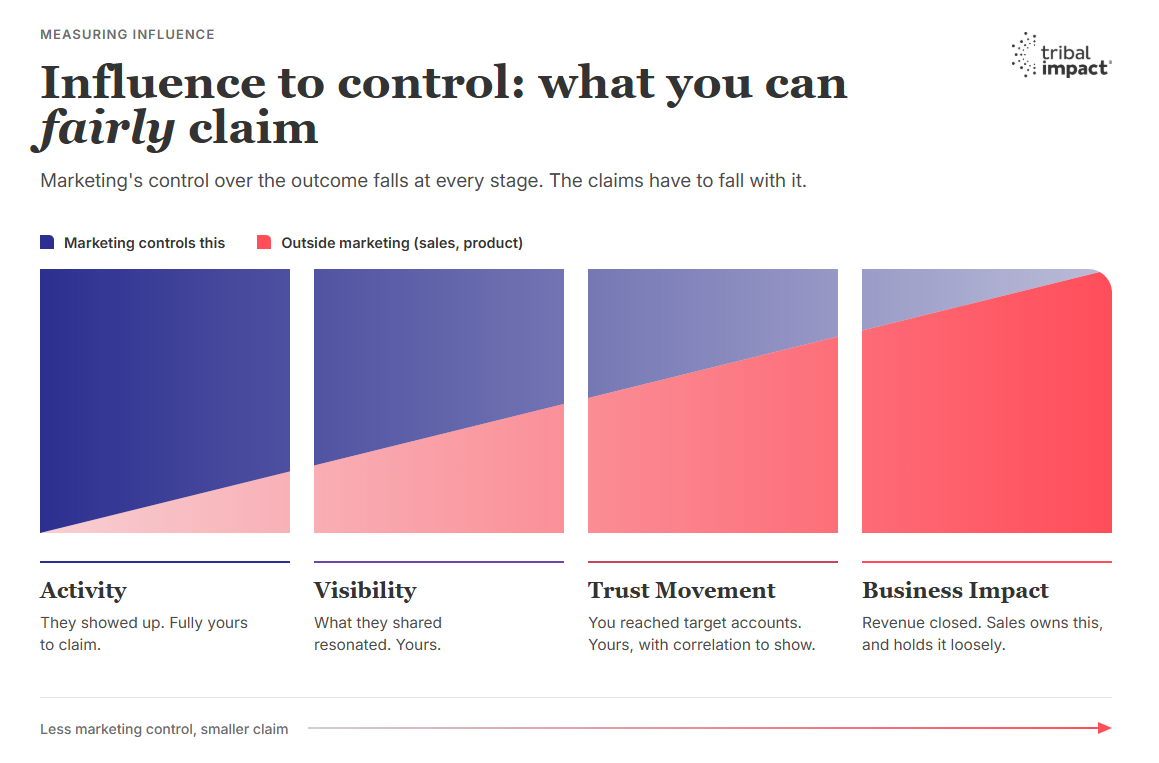
The product might be strong or weak. The salespeople might close brilliantly or poorly. Marketing influences whether the meeting happens; what happens in the meeting belongs elsewhere.
So, the rules look like this.
- Claiming you built visibility into an account, including through paid, is legitimate.
- Claiming you helped grow targeted connections into an account is legitimate.
- Claiming you influenced the opportunity, with the correlation to show for it, is legitimate.
- Claiming you created the opportunity or drove the revenue belongs to sales, and even sales should hold that claim loosely, because the meeting a salesperson booked was itself influenced by the paid activity, the connections and everything else the system did around it.
A connected programme of influence works precisely this way: everyone influences, and the dashboard shows correlation over time. That is what a growth engine's measurement looks like.
The cost of ignoring this arrives at budget time. A dashboard that claims opportunities it merely influenced gets one hard question from finance, fails to answer it, and takes the whole programme's credibility down with it.
Where the platform dashboard ends
Most employee advocacy programmes stop measuring at the Activity stage: how many people shared, how many posts were shared, how many impressions. The better ones reach into Visibility: engagement per share, engagement rate.
Trust Movement begins where the platform data meets everything else. The value arrives when you extract the advocacy data and overlay it: account influence and buyer intent from Sales Navigator, connection data from LinkedIn, mapped against the accounts and audiences in the strategic goal.
For example, which sales employees in a specific country are using the tool and what is happening to the accounts they are trying to influence? The overlay is the measurement - it's the pattern over time. It is where the leading indicators get correlated back to what the business cares about, where the budget conversation changes character, and where our own work with clients concentrates, because it is the stage the tools were never built to reach.
Layers at different stages and what to report
Can different parts of one organisation sit at different stages at once? Constantly. Most functional programmes are stuck at the leading indicators:
-
Executive visibility programmes rarely see past follower counts, posts and engagement per post; advocacy programmes rarely see past leader boards, shares, clicks and impressions;
Digital selling programmes rarely see past SSI scores and follower growth.
Each silo polishing its own activity metrics is the pattern our whole 'Human Go-To-Market Growth Engine' model exists to break. The programme lead who sees influence as a connected system reports differently.
-
Trends over totals: follower growth rather than followers, average posts per month and its direction rather than a post count, engagement rate trending rather than engagement volume.
-
Relationships over layers in isolation: how executive activity moves employee activity, how each sales leader's behaviour moves their own team's. Report the layered picture, because the layers behave as a system and the averages make the system visible.
Look at a global sales organisation this way and you can tell a regional leader where the EMEA sales team sits below the company average or against the LATAM team. Within the region, Germany might sit below both its country peers and the regional average. North America might sit above the company average while the west coast sits below both its own region and the company average. Example dashboard below.
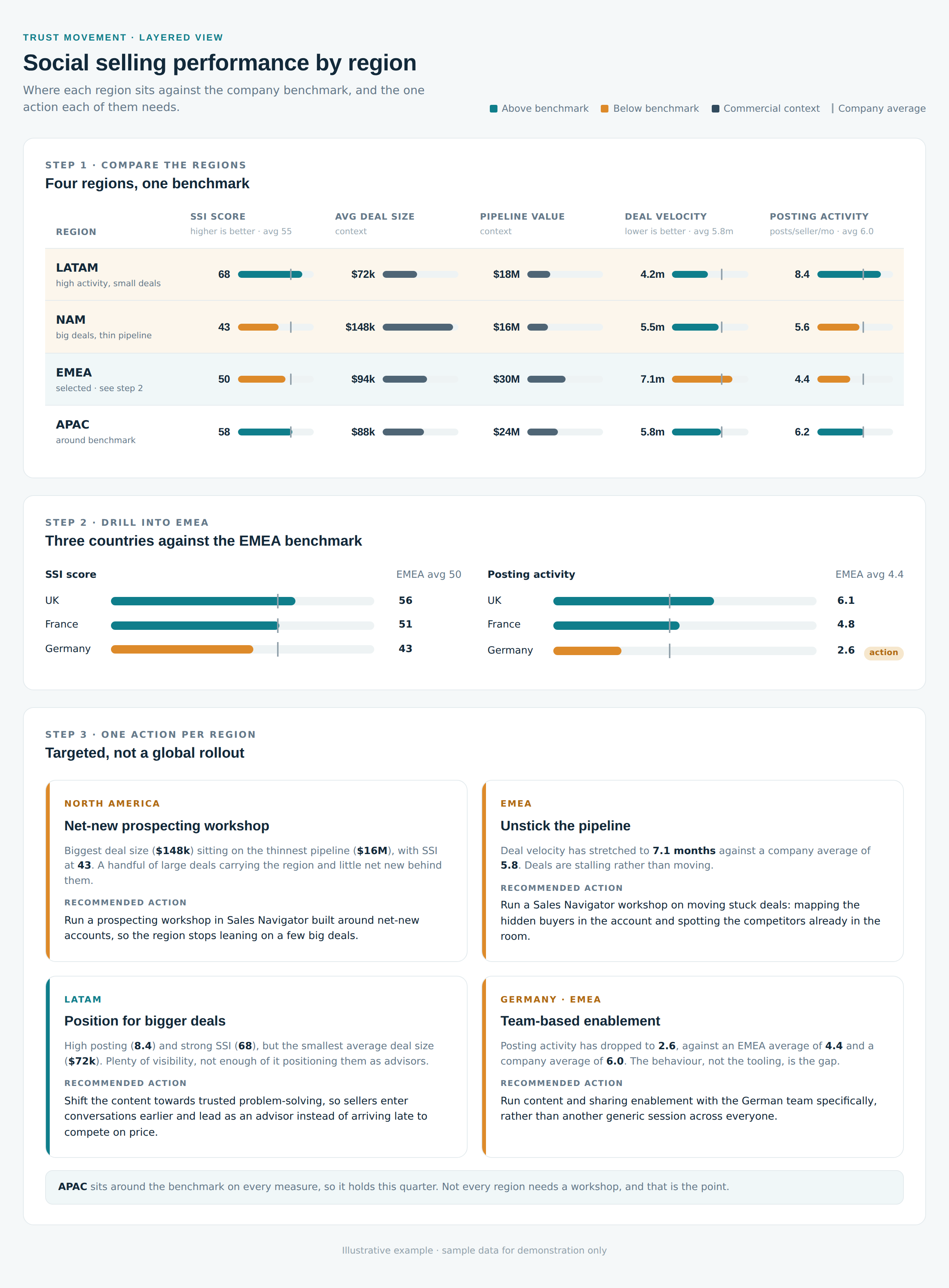
Hold that picture and enablement stops being generic. The training budget goes to the right teams, at the right time, in the right format, in place of the "How to use LinkedIn Sales Navigator" sessions rolled out to everyone that miss the point entirely.
Targeted enablement spend is a cost-saving measure before it is anything else, and cost saving is a language the CFO speaks fluently. That is a second conversation the model wins you!
The 9 maturity stages of employee influence and advocacy provide a useful framework for understanding why different layers and groups need different enablement.
The route out of the functional silo
The four stages are, in the end, a translation device. Activity and visibility are the programme's language. Business impact is the CFO's language. Trust Movement is where the two meet and the programmes that measure it are the ones who can defend their budget.
The behavioural research underpinning the model, across 860 B2B companies and three years, is free to read: The Human Edge report.
If you want to know where your programme sits on the four stages and where your layers sit against the 860, get in touch. Locating yourself on the model is the first honest step towards moving along it.
Frequently asked questions
How do you measure the ROI of a social selling or employee advocacy programme?
Track four stages in order: Activity (are people showing up), Visibility (does what they share resonate), Trust Movement (is that resonance reaching the accounts the business chose), and Business Impact (what it produced). The mistake most programmes make is measuring Activity, then claiming Business Impact, and skipping the Trust Movement evidence in between.
What is Trust Movement?
Trust Movement is the set of metrics that sit between leading and lagging indicators. It is the proof that employee visibility is shifting commercial relationships with target accounts: buyer intent moving in Sales Navigator, meetings booked with target clients and senior connections growing inside those accounts.
What is engagement per share and why does it matter?
Engagement per share measures whether someone understands their audience rather than how often they post. High engagement per share is the sign of mindful sharing: fewer, more relevant posts. Low engagement per share usually means someone is sharing to look active and score leader board points.
Why do social selling and advocacy programmes lose their budget?
Because they can only report in their own functional language, impressions, shares and SSI scores, none of which answer the questions finance asks at budget renewal. Without Trust Movement evidence tied to a strategic goal, the dashboard cannot show progress a CFO recognises.
Can marketing claim revenue from social selling?
No. Marketing can legitimately claim it built visibility into an account, grew targeted connections and influenced an opportunity with correlation data to show for it. Creating the opportunity and driving the revenue belong to sales. The further along the model you go, the less control marketing has, so the claims have to shrink to match.
Related Tribal Impact reading