.png?width=200&height=92&name=Tribal%20Logo%20Dark%20Grey%20(1).png)
Employee ambassador programmes often start with plenty of energy. People sign up, complete their training and begin sharing content. Six months later, participation drops.
The usual response is to look at the content or the platform. Do we need more content? A new campaign? A different advocacy tool? Another cohort of ambassadors? Sometimes those changes will help. In my experience, the bigger problems tend to sit elsewhere.
An active employee ambassador programme isn't simply one where employees keep posting. It's one where employees consistently build their professional influence in ways that support a defined business goal. That means developing expertise, relevant networks, visibility and trusted relationships over time.
That's a different way to think about keeping a programme active.
Key takeaways: How Do You Keep an Employee Ambassador Programme Active In 2027?
- Personal value sustains participation. Show ambassadors how their influence is growing.
- Recruit for motivation and readiness. Combine volunteers with data-led invitations.
- Measure influence, not just activity. Look at visibility, relevant engagement and Trust Movement.
- Scale capability before headcount. Build sustainable habits before adding more people.
- Quality beats volume. Expertise-led content matters more than frequent corporate reshares.
Why do employee ambassador programmes lose momentum?
Employee ambassador programmes lose momentum when participation becomes another task rather than something employees can see is building their own influence. Sustainable programmes give ambassadors evidence of progress: stronger professional networks, greater visibility around their expertise, relevant engagement and conversations with the audiences they want to reach.
Most programmes spend a lot of time teaching ambassadors how to use LinkedIn, what to post and how often to show up but far less time helping them understand whether any of their effort is working.
It's normal that program managers want to know how many ambassadors are active? How many times have they shared? What reach have they generated?
Employees, on the other hand, have different questions.
-
Is my network growing?
-
Am I becoming known for my expertise?
-
Are the right people engaging with me?
-
Is my content starting conversations?
-
Am I building a stronger professional reputation?
Ambassadors need to understand their own progress as much as they want to understand their impact on the wider programme.
Show people what's changing. Teaching them how to interpret their own data. Provide feedback on what's working and where they could improve.
There's a wider behavioural effect too. Our Human Edge research tracked LinkedIn activity across 860 B2B companies over 40 months. We found that in 82% of companies, when leadership activity increased, employee activity followed. When leaders went quiet, employees usually followed within two months.
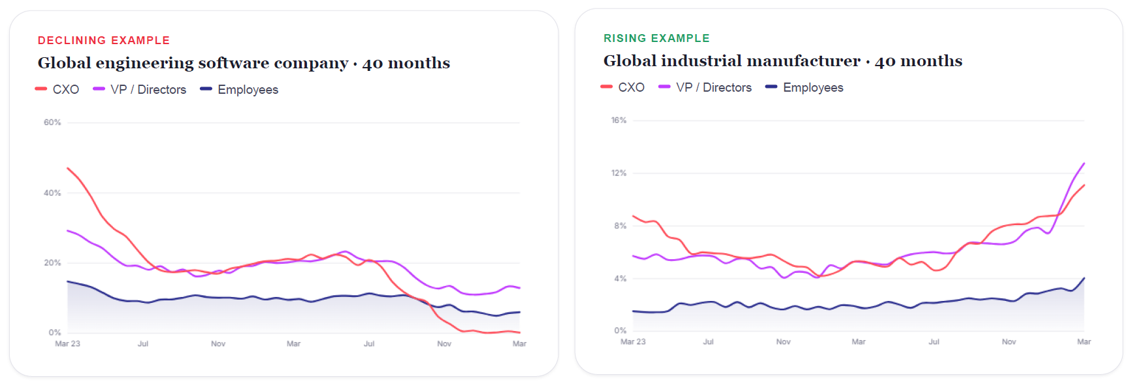
Ambassador behaviour doesn't develop in isolation. The environment around the programme matters too.
Should employee ambassador programmes rely on volunteers?
Employee ambassador programmes shouldn't rely on volunteers alone. Volunteers bring intrinsic motivation, but they may be starting with a small network, an underdeveloped profile and few established LinkedIn habits. I prefer a combination of opt-in and invitation: let motivated people volunteer, while also identifying people already demonstrating the behaviours you want to develop.
This comes up quite often in conversations I have with employer branding professionals. We'll talk about using data to identify employees who are already active on LinkedIn and showing some of the behaviours you'd want from an ambassador, and the response is often: I'd rather ask for volunteers.
I understand the thinking. You want people who genuinely want to be there. The challenge is that willingness and readiness aren't the same thing.
Someone can be enthusiastic about joining but start with a small network, an incomplete profile and few established habits around posting, commenting and networking. They can become a strong ambassador, but there's more groundwork to do and it'll take longer. If you're hoping to demonstrate impact within six months, that starting point matters.
This is why I wouldn't choose between volunteers and data-led identification. I'd use both. Give people the opportunity to put themselves forward, while proactively inviting employees who are already demonstrating the behaviours you want to develop.
What about employees who are nominated to become brand ambassadors?
We've all seen the other approach: the employee who has been “voluntold”. Perhaps they're senior. Perhaps they're a subject matter expert. Perhaps someone in marketing thinks they'd make a brilliant ambassador.
None of that means they want to do it.
You can teach someone how to use LinkedIn. You can improve their profile, give them content ideas and show them what good looks like. Creating the motivation to keep showing up is much harder.
This is why I'd use a combination of opt-in and invitation.
Open the programme to people who want to participate, with a clear explanation of the commitment involved up-front. Then use the data to identify employees already demonstrating some of the behaviours you want to develop and invite them too.
How should you choose employee ambassadors?
The best employee ambassadors aren't necessarily the people with the largest networks or the first people to volunteer. Look for a combination of motivation, network strength and existing behaviours such as posting, commenting and engaging. Then use influence maturity mapping to understand what each person needs to develop.
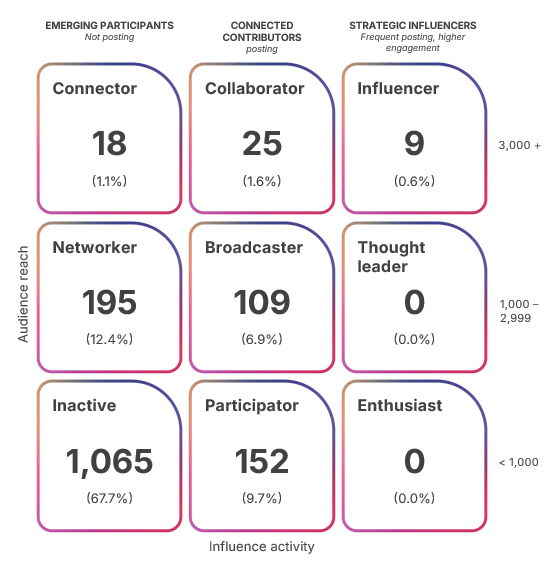
Our influence maturity matrix above provides an example overview of how your employees might map.
We're not looking for perfect LinkedIn users. Someone might have built a strong network but post inconsistently. Someone else might share too much company content. Another employee might have strong expertise and good engagement but no clear content strategy.
Those are useful starting points because you're improving behaviours that already exist. A few adjustments to content mix, consistency, network building or engagement can have a much faster impact than starting from scratch.
The invitation matters too. I wouldn't say:
We'd like you to become an ambassador and share more about the company.
I'd position it around the employee:
We've noticed you're already building a strong presence around your expertise. We'd like to give you the insight, skills and support to develop that further.
There's a much clearer reason for the employee to say yes.
What should you measure in an employee ambassador programme?
Employee ambassador programme measurement should track the progression from activity to visibility and Trust Movement. Activity shows whether employees are participating. Visibility shows whether their expertise is reaching and engaging relevant audiences. Trust Movement looks for early signals of influence, such as relevant network growth, repeat engagement, new conversations and stronger connections into priority audiences.
Activity still matters. You need to know whether people are participating. The issue is when activity becomes the definition of success.
Someone sharing five pieces of company content every week can look fantastic on an advocacy dashboard.
Someone publishing one thoughtful post that generates a conversation with exactly the people your business wants to reach may look less active.
I'd want to understand consistency, engagement per share, relevant network growth, who is engaging and whether the employee is becoming more visible around their expertise.
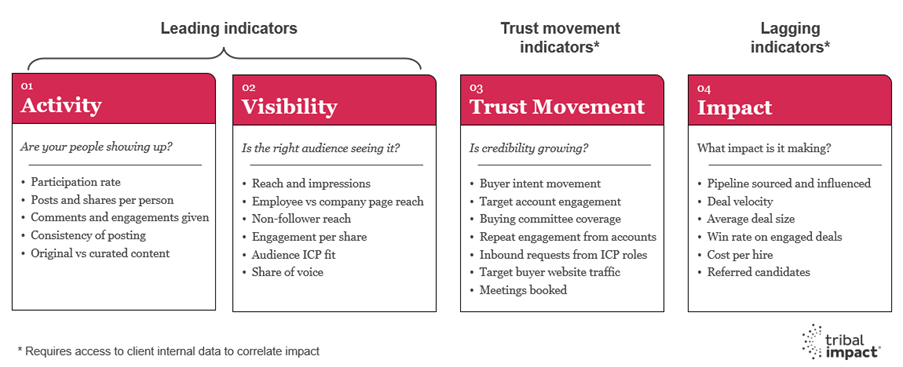
The measurement framework above outlines the four stages we move clients through when measuring impact.
AI makes this even more important.
LinkedIn's 2026 AI Search research found that 75% of LinkedIn citations came from individual member profiles, compared with 25% from Company Pages. It also found that job title mattered less than demonstrated expertise, with AI favouring credible voices publishing consistently within a niche.
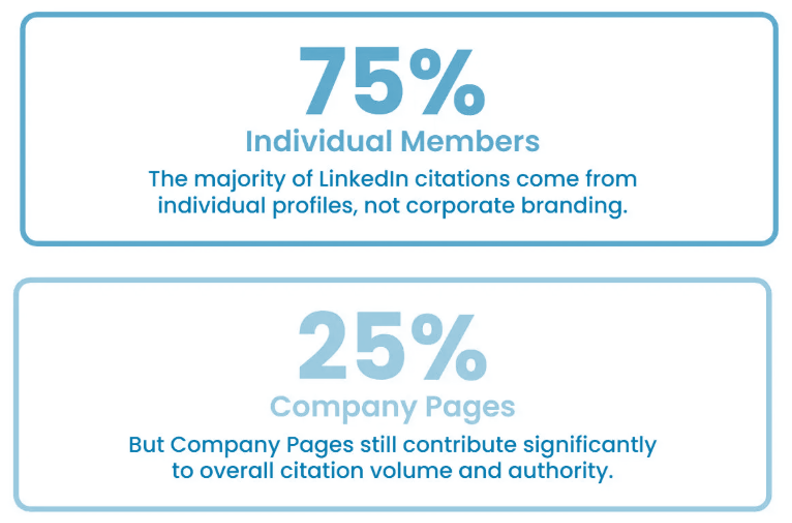
(Source: Meltwater)
The same guide reports that 95% of citations to LinkedIn content come from original posts rather than reshares.
That's a strong reason to move ambassador programmes beyond distributing company content.
Your employees' expertise has value, both to the candidates you're trying to reach with your EVP and increasingly to the AI systems those people are using to find information.
How do you scale an employee ambassador programme?
The most sustainable way to scale an employee ambassador programme is to scale capability before headcount. Develop employees according to their current maturity, build the skills and habits they need to become increasingly independent, then activate the next cohort.
This is where I see established programmes getting stuck. The first cohort has gone well. The programme needs more impact, so another 100 people are onboarded.
Now you've got another 100 people to onboard, train, engage and keep active.
I'd look at the people you've already got first.
-
Who has the motivation but needs help finding their expert voice?
-
Who needs a stronger network?
-
Who needs a content strategy?
-
Who would benefit from storytelling skills?
-
Who needs to become more consistent?
-
Group people by their maturity and give them the support they need at that point.
Then move them forward.
The aim is to make people increasingly capable of building their own influence, rather than increasingly dependent on the programme team to keep them active.
We've seen the impact of this shift in our own client work. In one global healthcare and pharmaceutical programme, around 15% of employees were active on LinkedIn, but only 4–5% were consistently creating authentic, story-led content. Personal storytelling generated three to five times stronger engagement than corporate reshares. Following the programme, employee posting increased 27% within six months and engagement with employee-generated content increased 40%.
That's the difference between having employees who are technically active and developing people who know how to build influence.
How do you connect an employee ambassador programme to employer brand goals?
Employer brand ambassador programmes should start with the talent audience the organisation needs to influence, rather than the number of employees it wants to activate. Identify the skills, locations and communities the business needs to reach, then find employees with the expertise, credibility and networks to reach those audiences.
Perhaps you need cybersecurity specialists in Germany. More women in engineering. Experienced data scientists. Graduates in the USA.
Now look inside the organisation.
-
Who has credibility in those areas?
-
Who has experience that audience would value?
-
Who is already connected to those communities?
-
Who could become more visible within them?
That gives the programme a clearer purpose. It also changes the measurement.
If you're trying to attract cybersecurity specialists in Germany, total reach tells you very little. I'd want to know:
-
Are our ambassadors are building connections within that community.
-
Are those people engaging with their content?
-
Is their relevant following increasing?
-
Are you seeing more traffic from that audience into your careers content?
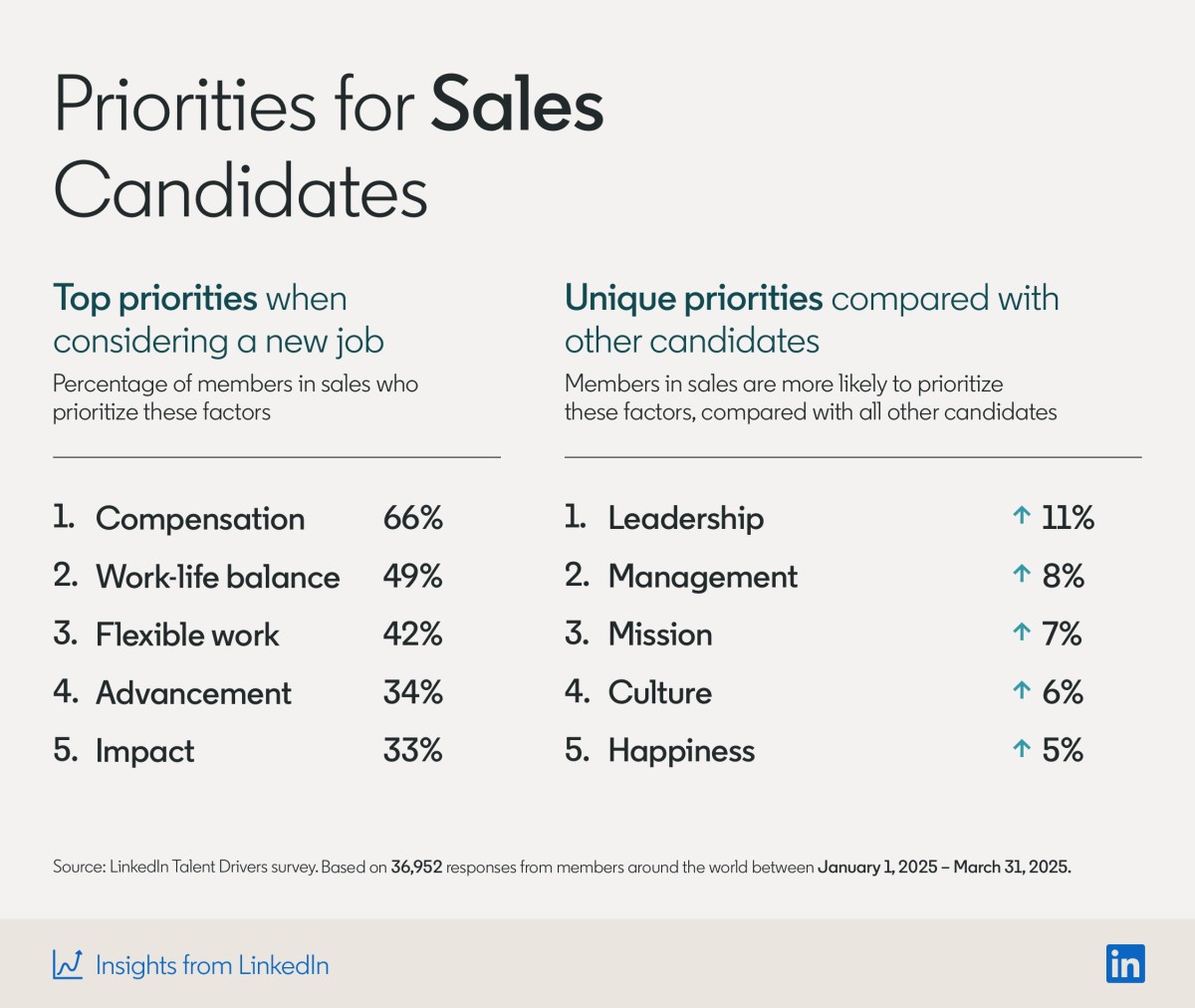
LinkedIn's 2025 candidate research, based on 73,856 responses from members around the world, found that candidate priorities vary by function, location and skill set. Sales professionals, for example, place more emphasis on clear leadership and effective management, while healthcare talent places particular importance on culture and inclusion.
Know who you're trying to influence first. Then find the people inside your organisation who can credibly reach them.
Can posting less improve an employee ambassador programme?
Yes. An employee ambassador programme can become more effective while employees post less. Posting frequency tells you how active somebody is; it doesn't tell you whether they're becoming more influential with the audience you're trying to reach.
We've seen this in our work with a specific healthcare client. The programme focused heavily on participation and volume. We worked with a smaller group on their behaviour, expert voice and ability to tell stories from their own experience.
Their posting frequency dropped but their post engagement rates increased. Their networks grew. Their follower count grew meaning their content was driving value for their audience. They were becoming more visible within their field of expertise.
If we'd only looked at activity, we could have concluded that performance had fallen.
There's an important credibility point here too.
A 2025 Academy of Management study explored employee-generated content on LinkedIn, Instagram and Glassdoor through interviews with 40 participants. It found that the platform affected how credible employee content appeared. On LinkedIn, its professional and career-focused environment could lead employee-generated content to be perceived as exaggerated and less trustworthy.
If we give employees polished corporate messaging and ask them to distribute it from their personal profiles, we risk losing the credibility that made their voice valuable in the first place.
I'd rather see fewer posts based on someone's expertise, experiences and perspective than a high volume of content that could have come from the company page.
What should you do when an employee ambassador programme starts to stall?
When an employee ambassador programme starts to stall, diagnose the behaviour before adding more content, switching technology or people. Look at who remains active, why others stopped, whether ambassadors can see their own progress and whether the programme is developing influence or simply generating activity.
I'd look at seven things:
- Who's still active? Look at the behaviours your strongest ambassadors have in common. Maybe they're posting natively rather than through the advocacy platform - that can be a good sign!
- Who stopped and why? Find out whether they could see enough value from participating.
- Can ambassadors see their own progress? Show people what's happening to their network, visibility and engagement.
- Are you recruiting the right people? Combine genuine volunteers with data-led invitations to people already showing potential.
- What are you rewarding? Look beyond volume towards consistency, audience quality, engagement and network growth.
- Does everyone need the same support? Develop people according to their current maturity.
- What business outcome are you trying to influence? Be clear about the audience you need to reach and why.
Keep coming back to one question:
Why would an employee want to stay active?
If they can see their network improving, their expertise becoming more visible, their confidence growing and the right people starting to engage with them, there's something in it for them too.
That's when an employee ambassador programme has a much better chance of becoming both sustainable and scalable
FAQs
How do you keep employee ambassadors active?
Show employees the value they're getting from participation, including stronger networks, greater visibility and growing influence.
Should employee ambassador programmes be voluntary?
Use a combination of volunteers and proactive invitations to employees already demonstrating strong behaviours.
How do you measure an employee ambassador programme?
Track activity, visibility, Trust Movement and business impact rather than relying on posting volume and reach alone (these are Activity metrics).
How do you scale an employee ambassador programme?
Develop the capability and habits of existing ambassadors before continually adding new cohorts.