.png?width=200&height=92&name=Tribal%20Logo%20Dark%20Grey%20(1).png)
If the numbers in your employee advocacy dashboard have been sliding, your people sharing as often as ever while reach and engagement fall, you are not imagining it - your programme is not broken in the way it looks. LinkedIn has changed how the feed works at a structural level and the clone-and-share model most advocacy programmes were built on now works against the algorithm.
LinkedIn used to count the signals around a post; the likes, the timing, the hashtags, the size of each person's network. It now reads the content itself, judges whether the person sharing it is credible on the topic and decides distribution on that basis. The same shift that handed search to the AI engines has reached the feed and your dashboard is showing the result.
Key takeaways: How LinkedIn's 360Brew algorithm changes are impacting employee advocacy programmes
- LinkedIn has replaced its signal-counting feed with 360Brew (or Brew360), a foundation model that reads content by meaning and ranks each person's credibility on a topic before it ranks the post.
- Clone-and-share programmes are losing reach across every participant because the model reads identical corporate posts as low-authorship and holds them back.
- The same shift now drives AI search, so getting your people seen in the feed and getting your company cited in ChatGPT have become one discipline.
- The programmes still growing are built on expert voices with coherent profiles, consistent topics and a point of view, rather than on volume of shares.
- Reach and engagement are leading indicators. Measure Trust Movement, the connections and intent shifts inside target accounts and audiences, to tie the programme to commercial outcomes.
What 360Brew changed on LinkedIn
360Brew is LinkedIn's foundation model for ranking and recommendation, a single large language model that replaced the signal-counting systems the feed used to run on.
Rather than tallying engagement around a post, it reads a member's profile, their history, their comments and the post together, then decides whether the content belongs in front of a relevant audience.
For a programme manager, the consequence is blunt. LinkedIn now ranks the person before it ranks the post.
Each advocate's credibility on a topic, read from their profile and what they have consistently talked about, influences how far their post travels. See an example below - ensuring keywords are embedded in the profile, posts and engagements.
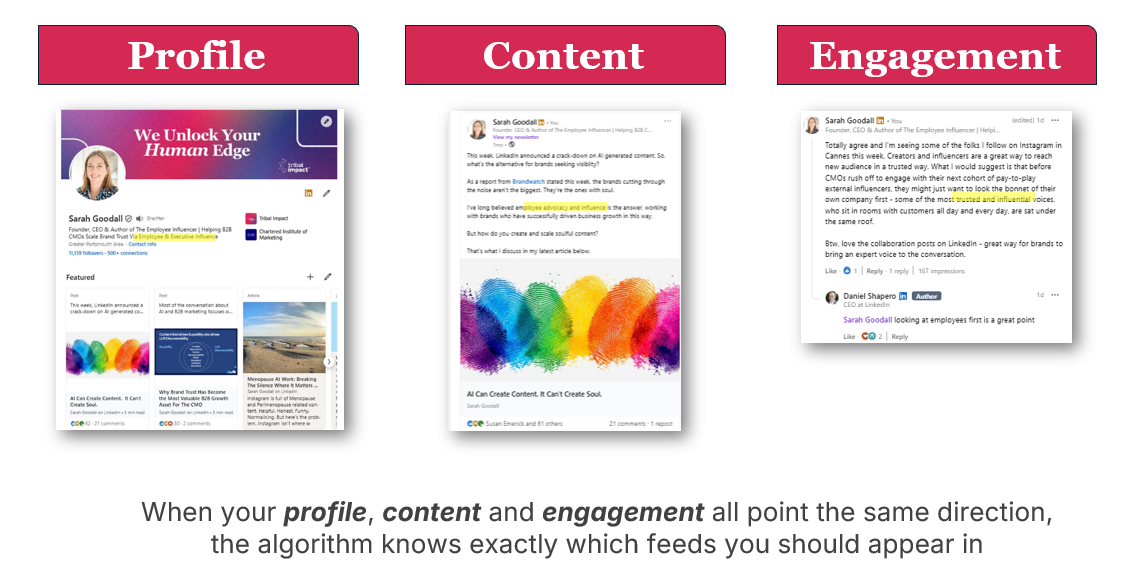
When you push the same corporate post out across the same set of people, you are no longer multiplying reach. You are repeating a pattern the model was built to spot.
The LinkedIn feed now reads like an AI engine
A model that reads and judges content by meaning is the same kind of technology now deciding who gets cited in ChatGPT, Perplexity and Google's AI answers. The LinkedIn feed has started reading your programme's content the way an answer engine does.
That collapses two problems marketing has been treating as separate. Getting your people seen in the feed and getting your company cited in AI search have become the same discipline.
Both reward proven, consistent expert voices talking about topics that match their profile and their network. Both discount volume, gaming, engagement pods and generic content. Build your programme for one and you are building it for the other.
For a practical perspective on using AI without losing the human voice, see how to boost employee advocacy and social selling with AI.
From employee advocacy to employee influence
We have argued for years that employee advocacy and employee influence are totally different. Advocacy has historically treated employees as a distribution channel for brand content. Influence builds authority in the people themselves. 360Brew has written that distinction into LinkedIn's architecture and your dashboard is where you might be starting to feel it.
When dozens of participants share the same corporate post word for word, the model reads the absence of authorship and limits how far it travels. The clone-and-share mechanic that made programmes easy to scale is the exact pattern the feed now discounts.
Programmes built on volume are losing reach for every person who takes part, including the advocates who used to perform best.
Programmes built on expert voices are the ones still growing. The technology has made the case for influence better than we ever could.
For more on connecting employee advocacy with expert-led influence, read how employee advocacy and influencer marketing go hand in hand.
What the model rewards now
The signals worth rebuilding your programme around are the ones that prove expertise. Use them as a checklist for the programme you run today:
-
Profile and content coherence. Each advocate's posts need to match the expertise their LinkedIn profile signals, so the model has something to anchor a credibility score on. Treat every participant's headline and About section like a landing page, clear on the two or three topics they 'own'.
-
Topic consistency. An advocate who posts consistently within their area builds a credibility profile over time. Pushing people to share outside their pillars scatters that signal and costs them reach.
-
Genuine authorship. A single sentence of their own perspective on top of shared content signals a human author. Reposting without context signals the opposite, so your content needs to become something people build on, not broadcast.
-
A relevant network. A smaller, thematically coherent network strengthens the signal. Encourage advocates to connect with their community rather than chase follower counts.
-
Quality engagement. Substantive comments and saves count for far more than likes, so briefing your people on what strong engagement looks like matters more than asking them to like each other's posts.
The quiet winners here are the experts whose audiences rarely like or comment: the regulated-sector specialists, the technical leads, the leaders talking about problems buyers will not admit to in public.
A feed that reads for meaning rather than applause finally gives those people, and the programmes that back them, a fair hearing.
For guidance on turning employee advocacy into useful, audience-led content, see how to elevate your content strategy through employee advocacy.
What to stop measuring and what to measure instead
Most employee advocacy dashboards are still built around shares, impressions and likes - possibly earned media value (EMV). Those are the signals the feed now weights least. They show the content is landing but do not show it is moving an audience.
This is where we measure Trust Movement: the signals that show your programme's influence reaching the accounts the business cares about before demand is generated.
-
Connections growing into target accounts.
-
Repeat engagement from the buyers your sales team wants.
-
A shift in intent inside the accounts that matter.
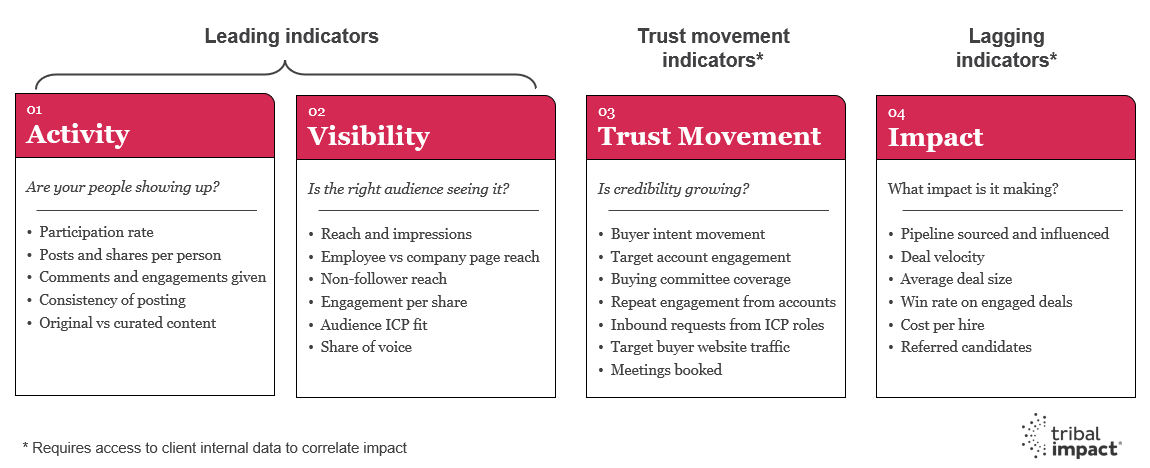
Reach and engagement tell you the programme is active. Trust Movement (above) tells you that influence is having an impact.
For a detailed framework on measuring employee advocacy programme success, explore Tribal Impact's measurement guide.
Score your programme in 5 minutes
Run your programme through these seven questions. Answer each one - yes or no. The pattern in your answers tells you why your reach is sliding and where to start.
- Are you tailoring enablement to each audience's maturity and role, or giving everyone the same generic "how to be visible on LinkedIn" training?
A sales leader, a technical expert and a first-time advocate start from different places. One training for all of them lands with none of them. - Do your advocates understand the value of a personal brand, and know how to find their expertise, their voice and the profile that reflects it?
360Brew reads the profile first. If your people cannot articulate what they are known for, the model cannot either. - Have you helped each advocate build a content strategy aligned to their own voice and expertise?
A strategy tied to two or three topics they own is what builds the credibility profile the feed now rewards. A calendar that sends everyone the same post does the opposite. - Have you given them ways to build the habits that keep posting consistent?
Consistency is a behaviour, not a campaign. Without habits, activity spikes then fades, and the credibility profile never compounds. - Have you given them direction on engagement, how to comment and why it matters?
Substantive comments now carry real weight in distribution. Most advocates are never shown what good engagement looks like. - Have you enabled them to read their own LinkedIn analytics and adjust their content based on what they see?
Advocates who understand their own numbers improve on their own. Those who do not stay dependent on you. - Are you relying on a handful of ambassadors to carry most of the activity?
In our experience the 80:20 rule holds here: around 20% of advocates generate roughly 80% of the engagement. A programme resting on the few is fragile, and it is a sign the enablement has not reached the rest.
Score it:
Mostly 'no' means your reach will keep sliding whatever your people post, because the enablement underneath is built for the old algorithm. You do not fix that with more content. You fix it by moving from generic training to enablement tailored to each person's role, expertise and maturity, so more of your advocates cross from activity into genuine influence.
Where to start:
When a programme scores badly, do not try to fix everyone at once. Map your employees onto our Influence Maturity Matrix first, so you can see where the easy wins are.
The people already active and bought into building their visibility are far quicker to work with than those you still have to convince to take a first step. Starting there gets you results faster, and it hands you something more valuable than any training deck: internal case studies of colleagues gaining visible traction, which is what finally moves the people sitting on the fence.
Frequently asked questions
Why has our employee advocacy reach dropped?
LinkedIn moved to a foundation model, 360Brew, that ranks content by meaning and credibility rather than engagement signals alone. Identical posts shared across many employees are read as low-authorship and distributed less, so programmes built on clone-and-share see reach fall across every participant. That is what most advocacy dashboards are now showing.
Does employee advocacy still work under 360Brew?
Yes, when it is built on authorship rather than clone-and-share. Advocates who add their own point of view on topics they are credible on are rewarded. Programmes that push identical corporate posts across many people are discounted.
What should we measure in our advocacy programme now?
Track saves, sends and comment quality alongside reach, since those are the engagement signals the feed now values. Then measure Trust Movement, the connections and intent shifts inside your target accounts, to connect the programme to commercial outcomes rather than activity.
How do we adapt our programme to 360Brew?
Shift from distributing finished corporate posts to equipping people to author from a point of view. Align each advocate's profile to a small set of topics, concentrate on your expert voices, and rebuild your measurement around quality engagement and Trust Movement rather than share volume.
Related Tribal Impact reading
- The 9 maturity stages of employee influence and advocacy
- How to build a pipeline of employee expert influencers
- How to elevate your content strategy through employee advocacy
- How employee advocacy and influencer marketing go hand in hand
- Transforming employee advocacy into business results
- How to measure the success of your employee advocacy programme
- How to boost employee advocacy and social selling with AI
- How to get C-suite buy-in for your employee advocacy strategy