.png?width=200&height=92&name=Tribal%20Logo%20Dark%20Grey%20(1).png)
Advocacy delivers reach. Influence delivers commercial impact. The difference shows up in what you measure.
Originally published on LinkedIn
Most employee advocacy programmes follow a familiar arc. They launch with energy, the early engagement numbers look good, then a few months down the line the momentum slows. The instinct at that point is to add more people, encourage more shares, introduce incentives and leader boards. The more useful move is to step back and ask why you're doing advocacy in the first place.
Advocacy has a real and lasting role. Asking your employees to share curated content is often the first step in their activation journey online and creates digital habits that everything else is built on. If your goal is reach, impressions and engagement, a well-run advocacy programme delivers exactly that.
The organisations that want more, the ones looking to unlock genuine commercial impact, are the ones evolving their programmes from advocacy to influence. The shift from advocacy to influence is, at its heart, a shift in what you count as success.
Key takeaways: The difference between employee advocacy and employee influence
- Advocacy and influence are the same people with a bigger ambition: advocates share company content and build reach, influencers build authority in their own voice and drive commercial impact.
- Advocacy is the essential first step. It creates the digital habits everything else grows from, and if reach is your goal it delivers.
- Programmes plateau when they chase volume. They compound when you measure Trust Movement: trust building towards a specific business goal, at the level of the accounts and outcomes you care about.
- Trust Movement indicators include new connections into target accounts, engagement on executive posts from inside those accounts, and talent traffic from the roles you want to fill.
- Buyers and AI now reward influence: hidden buyers keep sales at arm's length, and LinkedIn's 360Brew surfaces sustained expert voices rather than reshared brand links.
- Start from the outcome, not the volunteers. Map readiness against relevance on the Influence Maturity Matrix, begin with the few closest to the goal, and go deep before you go wide.
How do you measure employee influence?
Most programmes never escape the leading indicators: impressions, clicks, engagement, earned media value at best. They tell you something happened. They don't necessarily tell you how it moved the business.
We track a different set of signals called Trust Movement indicators. Trust Movement indicators are the metrics that show whether trust is building towards a specific business goal, measured at the level of the accounts and outcomes you actually care about.
In practice that looks like:
- New connections into your target accounts, from your people and your executives.
- Engagement on executive posts from people inside those accounts.
- Talent traffic to your careers page from specific roles or countries.
Tie the work of influence to an outcome the business already cares about, then watch whether a shift in employee behaviour has caused a shift in business impact.
A programme measured this way doesn't plateau in the same way, because you focus your effort on those employees that are creating the most influence and invest there first.
What does measuring employee influence look like?
Working with a global software company, we focused effort on the leaders and sellers closest to their priority accounts. C-suite connections inside their top 100 accounts rose by 15%, engagement on leadership posts climbed 37% and the influence tracked through to a 26% increase in pipeline for those AEs on the programme.
There's a structural consequence too. Once you measure influence against business goals, it can't stay buried in the social media team and judged on volume metrics alone. It becomes a strategic capability that touches sales, talent, executives and brand reputation - connected siloes of influence.
For a wider view of how advocacy connects to business results, explore Tribal Impact's guide to transforming employee advocacy into commercial impact.
What's the difference between an employee advocate and an employee influencer?
Employee advocate: An employee advocate is someone who shares their company's curated content, both branded and non-branded, through their own social media channels. They are taking the first step in building a public presence online, creating the digital habits that everything else grows from. Their value shows up in reach, impressions and engagement.
Employee influencer: An employee influencer is someone who has built genuine authority in their own voice, so they shape the conversations that matter to the business. They move beyond sharing company content and take part in the communities and conversations where their expertise lives, contributing original thinking with the confidence and skill to lead. Their value shows up in commercial impact: pipeline, accelerated opportunities and the talent that long-term resilience depends on.
An advocate distributes the company's content and builds reach. An influencer builds their own expert authority and builds trust.
Same people but a bigger ambition.
In the 2025 Edelman-LinkedIn B2B Thought Leadership Impact Report, 64% of decision-makers said they trust thought leadership content more than traditional marketing materials when judging what a company can actually do.
We've mapped the difference across 12 dimensions. For more on building credibility and original thinking on LinkedIn, see how to become a thought leader and grow on LinkedIn.
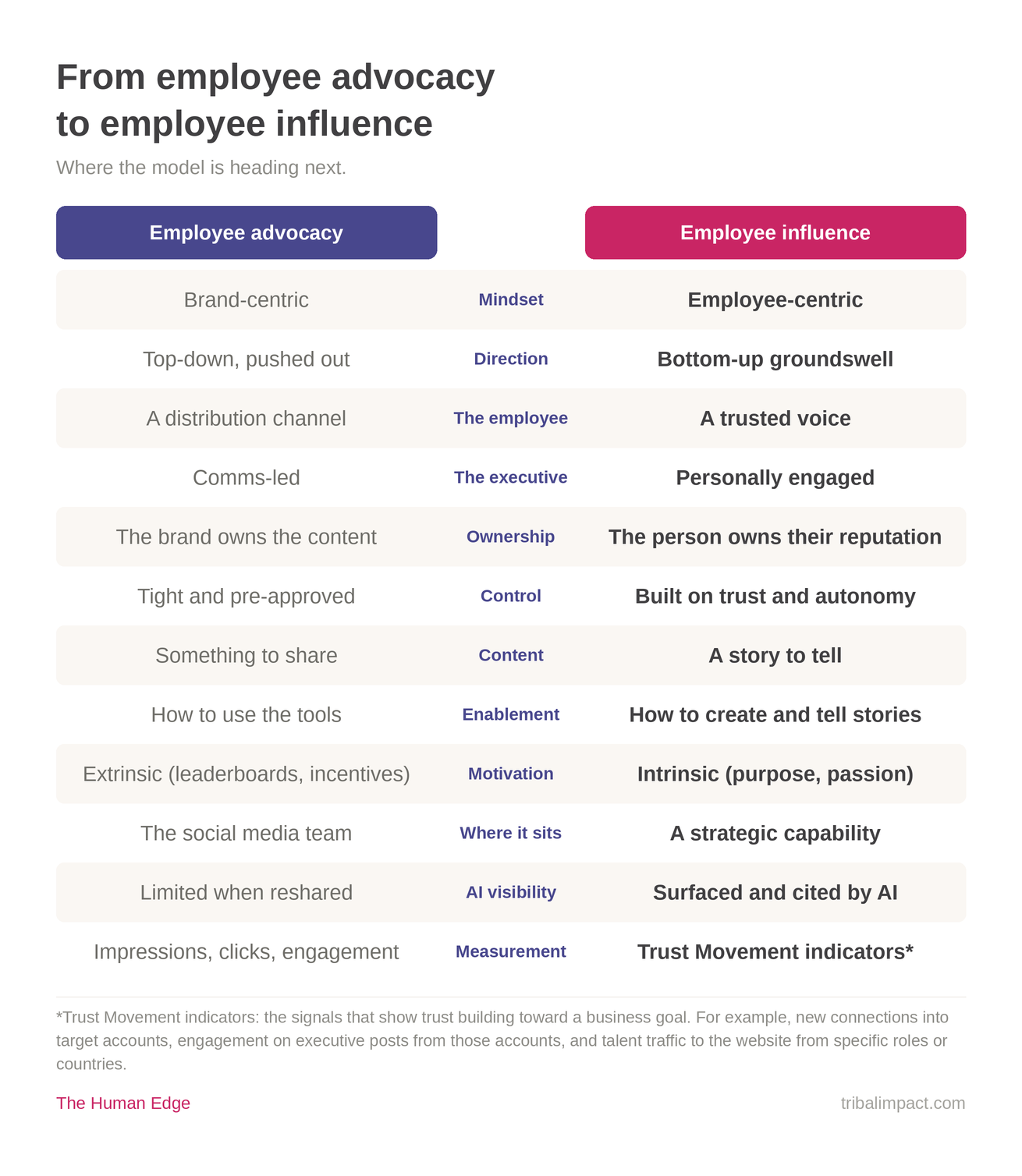
Why do buyers and AI now reward influence?
Two things have changed the rules. Buyers stopped trusting brand channels a while ago and many now keep salespeople at arm's length until later in their buying journey. The buying process now happens long before anyone fills in a website form.
In the same Edelman-LinkedIn research, 71% of the hidden buyers who shape B2B deals said they have little or no direct contact with sales during evaluation, while 95% said strong thought leadership makes them more receptive when outreach does come.
What's new is AI.
To earn a place in the answers these engines generate, you need real expertise attached to real people working at a real organisation. A common mistake marketers make here is turning to tools and paid reach, but you can't buy your way into the AI engines in the way marketers have traditionally bought visibility.
A reshared brand link builds very little for both the visibility of the employee or brand. A sustained expert voice becomes something the AI engines surface and cite. Authority of voice can't be switched on for the duration of a campaign and switched off again, so it has to be built by individuals over time. LinkedIn's 360Brew is the AI foundation model that powers how the platform understands and ranks people, content and connections.
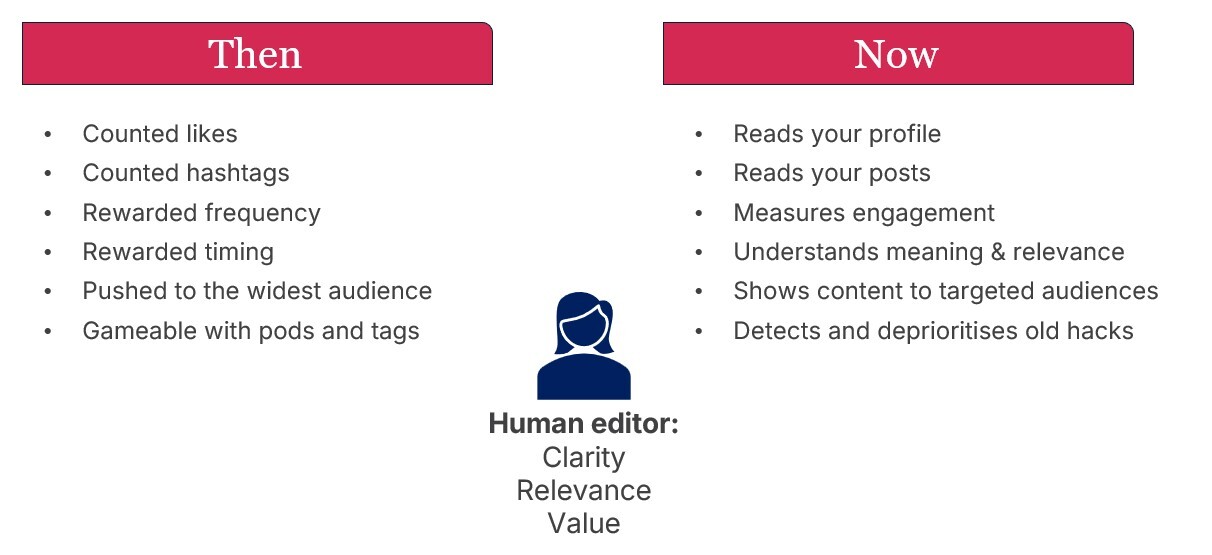
Introduced in January 2025, rather than rewarding algorithm hacks, it evaluates expertise, relevance, and relationships across your overall activity. For employee advocacy, this marks a shift from participation to expertise. Simply sharing company content is unlikely to build strong expertise signals. Employees now need to add their own perspective, contribute original thinking, engage in meaningful conversations and consistently demonstrate what they know.
For a practical example of using AI without removing the human voice, see how to boost employee advocacy and social selling with AI.
How do you start?
The standard playbook says to round up your keenest people, hand them content and turn on a leader board. That builds activity.
A programme built for commercial impact works in the other direction, starting from the outcome and the people who already demonstrate the digital confidence and skills. That includes your executives but we'll save that for another article.
Here's the sequence we use with clients.
-
Begin with the outcome, not the volunteers. Name the commercial goal first; the accounts you want to win, the roles you need to fill, the category you want to own. That single decision sets the standard for who matters and what good looks like.
-
Select for relevance, not noise. The keenest volunteer isn't always the most valuable voice. We map an employee's existing connections and engagement against the target account list or your target talent group, so you can see who's genuinely close to the audience you're chasing, rather than who simply posts the most.
-
Map readiness against relevance. Hold two things side by side: how ready someone is to build a public voice and how relevant their network is to the goal. The Influence Maturity Matrix sorts the first, showing who's ready to lead, who's building and who needs support. The people who score on both are where you begin.
-
Go deep before you go wide. Resist the pull to onboard everyone at once. A small group of the right voices going deep into the right audiences (accounts or talent targets) will move more than a hundred people sharing links. Prove the Trust Movement with the few, then expand from a position of evidence.
-
Enable for authorship, then protect the consistency. Shift the support from how to use the platform to how to build authority, tell a great story and keep a rhythm going. Influence compounds, so the advantage belongs to the people who keep showing up rather than the ones who post in bursts.
Do those five in order and you've built something that grows instead of plateauing, because every step is tied to an outcome you can measure.
For a current example of a global programme built around strategy, enablement, maturity and leadership, see Inside Henkel's approach to global employee advocacy.
The evolution of employee advocacy to employee influence
Advocacy got us here. It taught a generation of marketers that people trust people and that employee networks bring a level of trust that brands cannot reach via their organic channels.
Influence is the next chapter and it rewards the businesses willing to measure what actually matters. Get that right and your people don't just add reach. They build the trust that AI engines, buyers and future hires all act on.
That's the opportunity and it's sitting in your team right now.
*Statistics from the 2025 Edelman-LinkedIn B2B Thought Leadership Impact Report, a survey of 1,934 management-level B2B professionals across seven markets including the UK.
Frequently asked questions
What is the difference between employee advocacy and employee influence?
An employee advocate shares the company's curated content through their own channels, building reach, impressions and engagement, and creating the digital habits everything else grows from. An employee influencer builds authority in their own voice, contributes original thinking in the conversations where their expertise lives, and drives commercial impact: pipeline, faster opportunities and talent. Same people, a bigger ambition.
How do you measure employee influence?
Move beyond leading indicators like impressions, clicks and engagement, which tell you something happened rather than how it moved the business. Measure Trust Movement indicators: new connections into target accounts, engagement on executive posts from people inside those accounts, and talent traffic from the roles and regions you want to hire. Tie each to a business goal, then watch whether a shift in employee behaviour drives a shift in business impact.
What are Trust Movement indicators?
Trust Movement indicators are the metrics that show whether trust is building towards a specific business goal, measured at the level of the accounts and outcomes you care about. They sit between activity and revenue, giving you early proof that influence is working before the commercial result lands.
Does employee advocacy still work?
Yes, as the first step. Sharing curated content builds the digital habits and the reach that influence is later built on. The organisations that want commercial impact evolve those advocates into influencers who post in their own voice, since reshared brand links build little authority and LinkedIn's 360Brew rewards sustained expertise over one-off shares.
How do you start an employee influence programme?
Begin with the commercial outcome, not the keenest volunteers. Map each employee's readiness to build a public voice against how relevant their network is to that goal, using the Influence Maturity Matrix, then start with the few who score on both. Go deep with them before expanding, and shift your enablement from how to use the platform towards how to build authority and hold a consistent rhythm.
Related Tribal Impact reading
- The 9 maturity stages of employee influence and advocacy
- How to measure the success of your employee advocacy programme
- Transforming employee advocacy into business results
- How to boost employee advocacy and social selling with AI
- How to become a thought leader and grow on LinkedIn
- Inside Henkel's approach to global employee advocacy
- How to elevate your content strategy through employee advocacy