.png?width=200&height=92&name=Tribal%20Logo%20Dark%20Grey%20(1).png)
Originally published on LinkedIn.com
The four-stage model that connects employee posting activity online to pipeline.
Somewhere in a marketing team right now, a campaign manager is chasing a salesperson to ask this question: when you shared that post last week, did anyone mention or engage with it? If the answer is yes, they open the CRM and logs it manually. If the salesperson forgot, or never noticed, or simply doesn't reply to the ask, the influence that post created is lost.
This is how a many organisations measure employee influence (above the volume metrics we've all come to know around employee advocacy e.g. number of shares, number of engagements). This next level of measurement seeks to understand influence and runs on memory, goodwill and manual entry - plenty of opportunity for human error along the way!
The uncomfortable part for any marketer trying to prove the value of advocacy and influence is that they'll rarely show up in an attribution dashboard. The result? Teams continue to track activity and visibility metrics around posts shared, engagements achieved and reach. However, in a world where budget is tight, we need to think beyond that. The teams discovering the layer in between earn a more serious conversation.
Key takeaways:
- Advocacy measurement stops at activity and visibility, which never reaches the boardroom.
- Influence rarely shows in an attribution dashboard, because it builds over time through many small interactions, not one traceable click.
- The missing layer is Trust Movement: the signals that show influence reaching target accounts before revenue lands.
- Measure four stages: Activity, Visibility, Trust Movement, Impact. Most programmes skip the third, where credibility is built.
- Low engagement can signal you're getting it right, since buyers in regulated or sensitive sectors rarely engage in public.
- Measure all four stages and the conversation shifts from "nice-to-have" to business-critical, in language the board recognises.
Why employee advocacy never reaches the boardroom
Most organisations are measuring employee advocacy. Far fewer are measuring employee influence and the difference decides whether any of this reaches the board.
Advocacy measurement typically stops at visibility. How many employees shared. How many shares, clicks, impressions and engagements. At best, earned media value (EMV) which is the calculation to show how much would have been invested to reach x number of people.
All the time advocacy is run as a brand reach and awareness programme, it stays exactly where it sits today, inside a digital marketing and communications with no line to the numbers a boardroom recognises.
Then comes the attribution problem. Some employee advocacy tools offer UTM tracking - some tracking at a user level, so you can see which person in the programme drove a particular download or sign-up. That takes you a step further.
But here's the reality that marketers need to recognise.
Influence does not behave like a marketing campaign, where you do X and get Y. It happens over time, through consistency and relevance, in many small influential interactions that bubble up into a recognisable shift or change. Treat it as a chain of direct attribution and you will miss almost all of it.
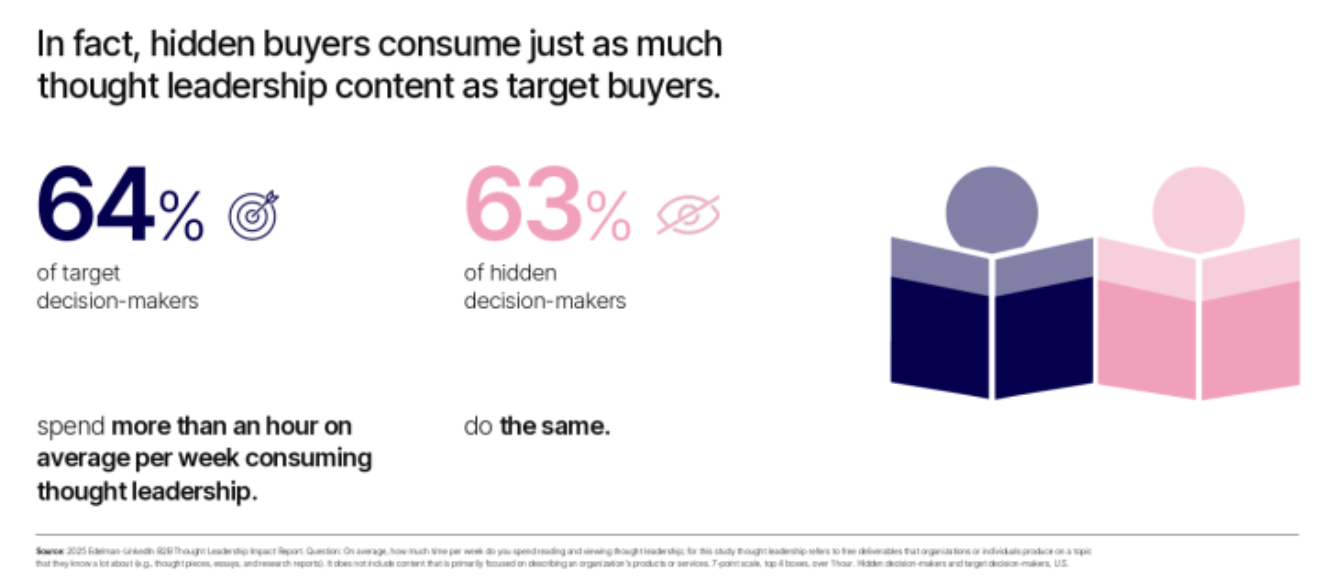
Recent research from Edelman and LinkedIn reinforces this point. Their 2025 B2B Thought Leadership Impact Report found that hidden buyers actively discover, consume and evaluate expert content alongside visible decision-makers, often long before purchase decisions become visible to sellers. In fact, more than 40% of B2B deals stall due to internal misalignment within buying groups. Influence is already happening, even when attribution systems cannot see it.
The missing layer: Trust movement
Between the activity you can see (e.g. number of people sharing, number of posts shared), the visibility you can measure (e.g. impressions, engagements, engagement p/share) and the revenue you want to create, there is a layer most organisations skip straight over.
We call it Trust Movement.
Trust Movement is the set of early signals that show influence is reaching the right accounts before it reaches commercial outcomes.
For marketing, this digs into how activity is influencing the accounts we want to grow, access or protect. For talent, this digs into how our ambassador group is driving more views from candidate personas we're trying to reach.
It's the bridge between leading indicators, the activity and visibility you can see this week, and lagging indicators, the business impact that takes months (sometimes years) to land.
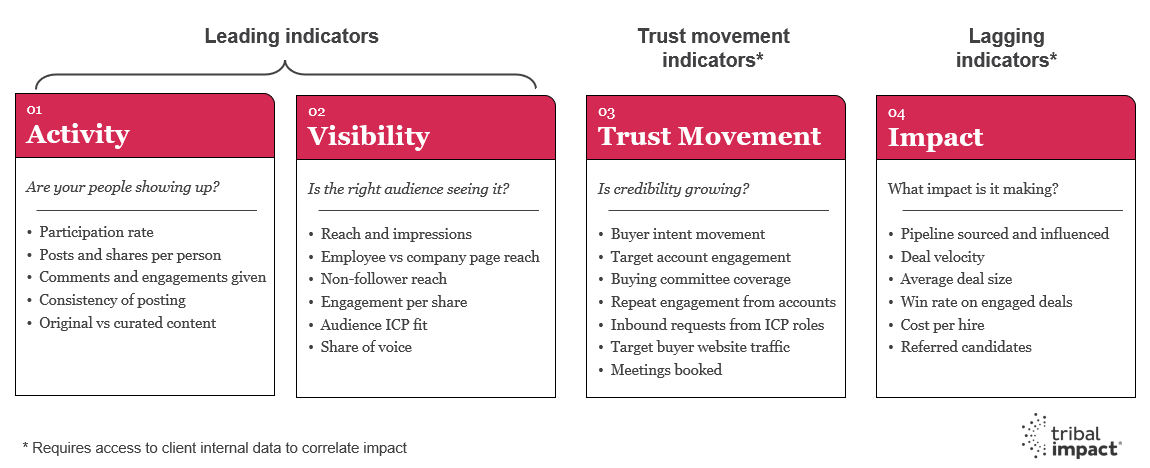
Think of measurement in four stages:
- Activity
- Visibility
- Trust Movement
- Impact
How to measure employee influence: the four-stage model
Most employee advocacy programmes count posts and impressions but as organisations evolve to employee influence, so must the measurement framework. Trust movement is the missing layer between volume metrics and commercial impact - it's the layer where credibility is built. Our four-stage model closes that gap.
- Activity asks whether your people are showing up. Participation rate, posting consistency, original content. Without this stage nothing else happens.
- Visibility asks whether the right audience is seeing it. Reach means little on its own. Employee reach versus company page reach, non-follower reach and audience ICP fit tell you whether the activity is working.
- Trust Movement asks whether credibility is moving. This is the rung most programmes skip. Repeat engagement from target accounts, buying committee coverage, inbound requests from the roles you sell to, meetings booked. When trust moves, buyers find you.
- Impact asks what it's delivering. Pipeline sourced and influenced, deal velocity, win rate on engaged deals, plus the talent metrics such as cost-per-hire, time-to-hire.
The first two stages are leading indicators. Measure all four and the CFO starts listening. They provide confidence that the activity and visibility is heading somewhere the board will care about, long before the pipeline number confirms it.
When low engagement is a sign you might be getting it right
There is a final trap in leaning on engagement, and it catches the teams doing the best work. If you're honing in on the real issues your buyers face (awareness stage/trust building level), those buyers often will not like or comment, because engaging in public admits they have the very problem you are describing. Legal, security, HR, regulated and government sectors all show this behaviour. In defence and government, the audience is often barred from engaging online at all.
A leader at a professional services firm posts regularly on LinkedIn, tuning into the issues his audience cares about. On the surface, you'd think his posts weren't doing well. Low engagement, zero comments, modest numbers. Speak to him and he has a sales pipeline built almost entirely on his activity, because he talks about the exact problems his buyers are sitting with. Judge that work on activity and visibility alone and you would call it a failure.
What to measure instead
So, here's the one thing to take to your leader. Stop trying to prove employee advocacy and influence through direct attribution. It won't show up there. Instead, measure the movements along the way, over time. Yes, it's more difficult but it moves the conversation around employee advocacy and influence away from being a 'nice-to-have' initiative to a business critical initiative.
Measure the activity. Measure the visibility. Then build the layer most teams miss, the Trust Movement Indicators that show influence reaching the accounts and outcomes you care about. That's the bridge between a programme that looks busy and a programme you can defend in the language the board understands.
Frequently asked questions
How do you measure employee influence?
Move beyond the activity and visibility metrics most advocacy programmes stop at, since influence rarely appears in an attribution dashboard. Use a four-stage model: Activity (are your people showing up), Visibility (is the right audience seeing it), Trust Movement (is credibility moving towards target accounts), and Impact (pipeline, deal velocity, and talent metrics). The first two are leading indicators; measuring all four earns the boardroom conversation.
What is Trust Movement?
Trust Movement is the set of early signals that show influence reaching the right accounts before it turns into commercial outcomes. It is the bridge between leading indicators you can see this week and lagging business impact that takes months to land. Signals include repeat engagement from target accounts, buying-committee coverage, inbound requests from the roles you sell to, and meetings booked.
Why doesn't employee advocacy show up in attribution?
Influence does not behave like a campaign where you do X and get Y. It builds over time through many small interactions that bubble up into a shift, and hidden buyers consume expert content long before a deal becomes visible to sellers. Treat it as a chain of direct attribution and you miss almost all of it.
What is the difference between measuring advocacy and measuring influence?
Advocacy measurement counts shares, impressions, clicks and engagement, which shows reach but stays inside marketing and communications. Influence measurement adds the Trust Movement and Impact stages, connecting employee activity to the accounts, pipeline and talent outcomes a board recognises.
Does low engagement mean a programme is failing?
Not always. When your people address the sensitive issues buyers face, those buyers often will not like or comment publicly, because engaging admits they have the problem. In regulated, legal, security and government sectors this is common, so judge the work on Trust Movement and pipeline, not likes alone.