.png?width=200&height=92&name=Tribal%20Logo%20Dark%20Grey%20(1).png)
Walk through the org chart of any B2B company running influence programmes and you will find a pattern. Sales enablement serves the sales teams. Comms serves the executives. Marketing serves the employees. Between the executives and everyone else sits the VP and Director layer, hundreds of people in a large organisation, and when you ask which function serves them, the room goes quiet.
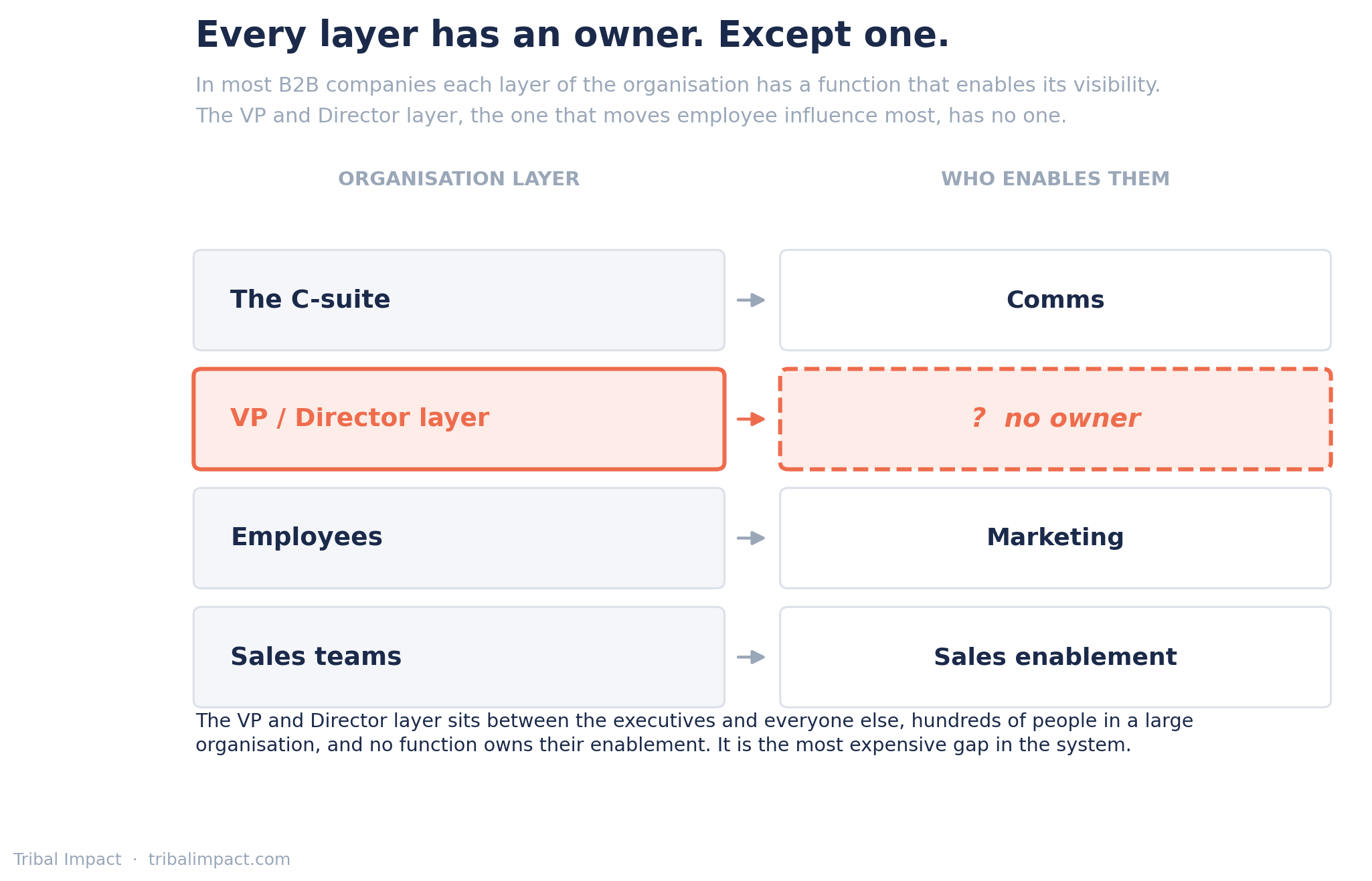
Our research across 860 B2B companies suggests this is the most expensive gap in the whole system. Companies with the most active VP and Director layer see 4x the employee posting of those with the least. The equivalent figure for the C-suite is 2.6x. The layer no budget touches is the layer that moves employee influence most.
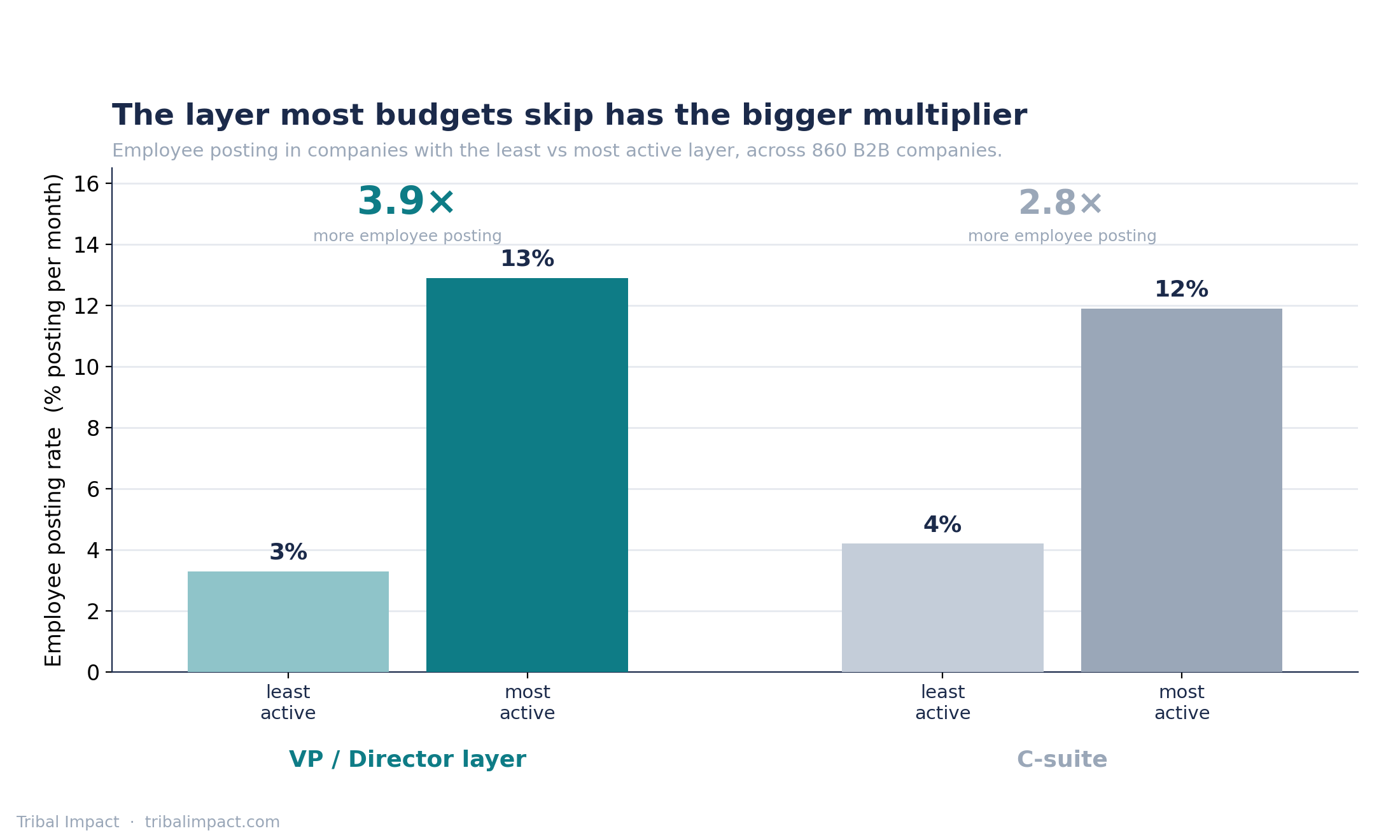
Executive visibility remains critical and plenty of organisations still underinvest there too. This article is about the layer below, because enabling it is a different problem with a different solution..
What "I don't have time" is really telling you
Ask a director to show up online and the first answer is nearly always time. Here is my honest view after eleven years of these conversations: if any layer in the organisation has earned that excuse, it is this one. VPs and Directors carry pressure from above and below at once. They sit inside the restructure conversations, the budget rounds, the KPI reviews, and they are out with customers between all of it.
Listen longer, though, and time reveals itself as shorthand for something else: I don't see the value, and I don't see how this helps my team do their job. "My job is pipeline, not posting" is the same sentence wearing sales clothing. Underneath sits a set of quieter fears: getting it wrong in public, striking the wrong tone, being judged by peers who think a leader with time to post has time they should be spending running the business. The easy escape from all of it is sharing company content, which gets a leader active while keeping them invisible, and everyone in their network can tell.
Every one of those objections dissolves the same way: by connecting the behaviour to what this layer already cares about. Their team's success. Their ability to attract talent to that team. Their own credibility as a leader customers and candidates can find. Value is the unlock.
Why the VP/Director layer can make or break your employee advocacy programme
A director's influence on your programme runs deeper than their posting rate. Their attitude replicates downward. I have sat in organisations where leaders asked, in open forums, why are we even asking our employees to do this? A single question like that, from the person a team calibrates against, can undo a quarter of enablement work.
This is why the goal with the middle layer is belief before activity. A director who understands the value and posts rarely will still reinforce, encourage and recognise the behaviour in their team and our data says that endorsement is where the multiplier lives. Win the layer's understanding and the activity follows, theirs and everyone below them.
The Leadership Multiplier Workshop: enabling hundreds of leaders at once
The coaching model built for the C-suite, one-to-one, ghost-written, high-touch, was designed for a handful of people and priced accordingly. It cannot stretch across a layer of hundreds, which is a large part of why this layer gets skipped. Scaling to VPs and Directors takes a different design, and after years of running these, the design that works is a group cohort. We call it the Leadership Multiplier Workshop, after the finding that justifies it.
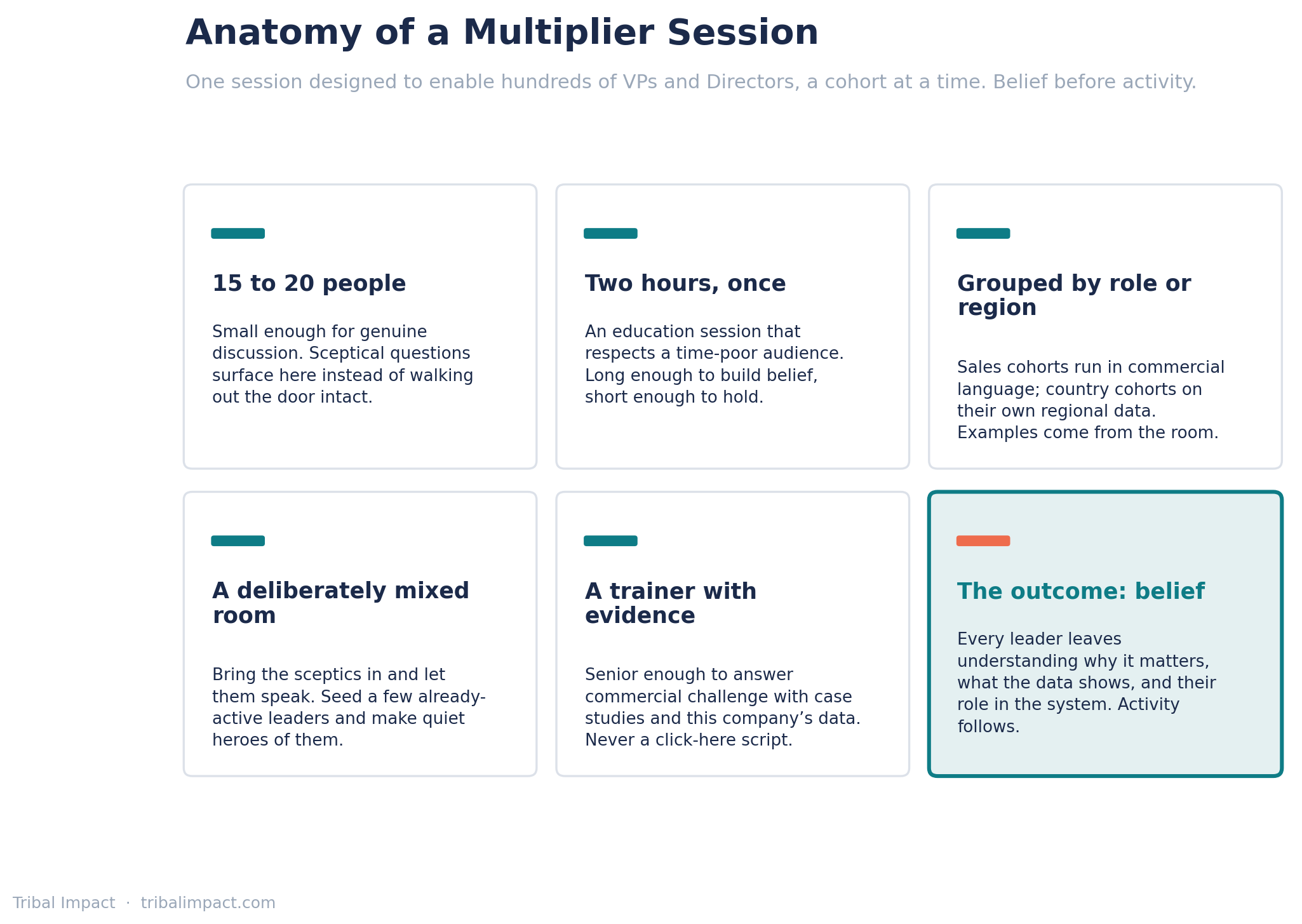
The mechanics matter, so here they are in full.
-
Fifteen to twenty people. Small enough for genuine discussion, which is the entire point. This layer arrives sceptical and full of questions they would feel daft asking in a larger forum. The room has to be safe enough for those questions to surface, because a fear voiced in the session is a fear you can answer; a fear kept private walks out the door intact.
-
Two hours, once. This is an education session, and it should respect exactly how time-poor the audience is. The purpose is for every leader to leave understanding four things: why the organisation is asking employees to be visible, why the executives are doing it, what the data shows inside their own company, and what their role in the system is. Leaders who leave curious will pursue more; the session's job is belief, and two hours is enough for belief.
-
Grouped by role or region. A cohort of sales leaders can be run in fully commercial language: pipeline, conversations, deal velocity. A cohort of country managers can be run through their region's own behavioural data. Whichever grouping you choose, the examples shown must come from inside it: employees from their region or their function doing it well, people they know or know of. Recognition of a familiar name does more persuading than any framework.
-
A deliberately mixed room. Bring the sceptics in and let them voice it; a session designed only for the willing educates nobody who needs it. Alongside them, seed a few leaders who are already active, showcase their examples, and let the session make quiet heroes of them, because the moment one peer says a customer mentioned my post in a meeting, the temperature of the whole room changes.
-
A trainer with evidence, never a script. This is where these sessions die. Talk at this audience for two hours and you have lost them. Send a practitioner armed with click-here instructions and you have confirmed their suspicion that this is a tactical exercise. The room needs someone senior enough to answer commercial challenge with case studies, examples of where programmes failed and why, and the data for this company. The session positions influence as a business growth driver, and the person delivering it has to be able to hold that position under questioning.
In our experience, these sessions work well with country managers and team leaders - anyone with people management responsibility where they will likely be hiring, onboarding and responsibile for engaging a team.
The KPI conversation you will need to have
Something happens with a converted director, most often in sales: they get it, they get excited, and they reach for the tool they trust. Right, everyone on my team posts twice a month, I'll hammer it. I love the ambition, and the instinct deserves careful handling, because a posting quota measures the wrong success.
Mandated activity produces compliance posting, brand links pushed out of the advocacy tool to keep the manager satisfied, and everyone in the audience can smell it. The outcome that matters is conversations and pipeline, and that comes from salespeople sharing customer stories and answering customer questions, content with judgement in it. The programme lead's line, delivered inside the session and repeated after it: we are after business impact, and activity is only the first stage of it. Frequency can sit in a cadence agreement; quality has to come from understanding, and understanding is what the session exists to build.
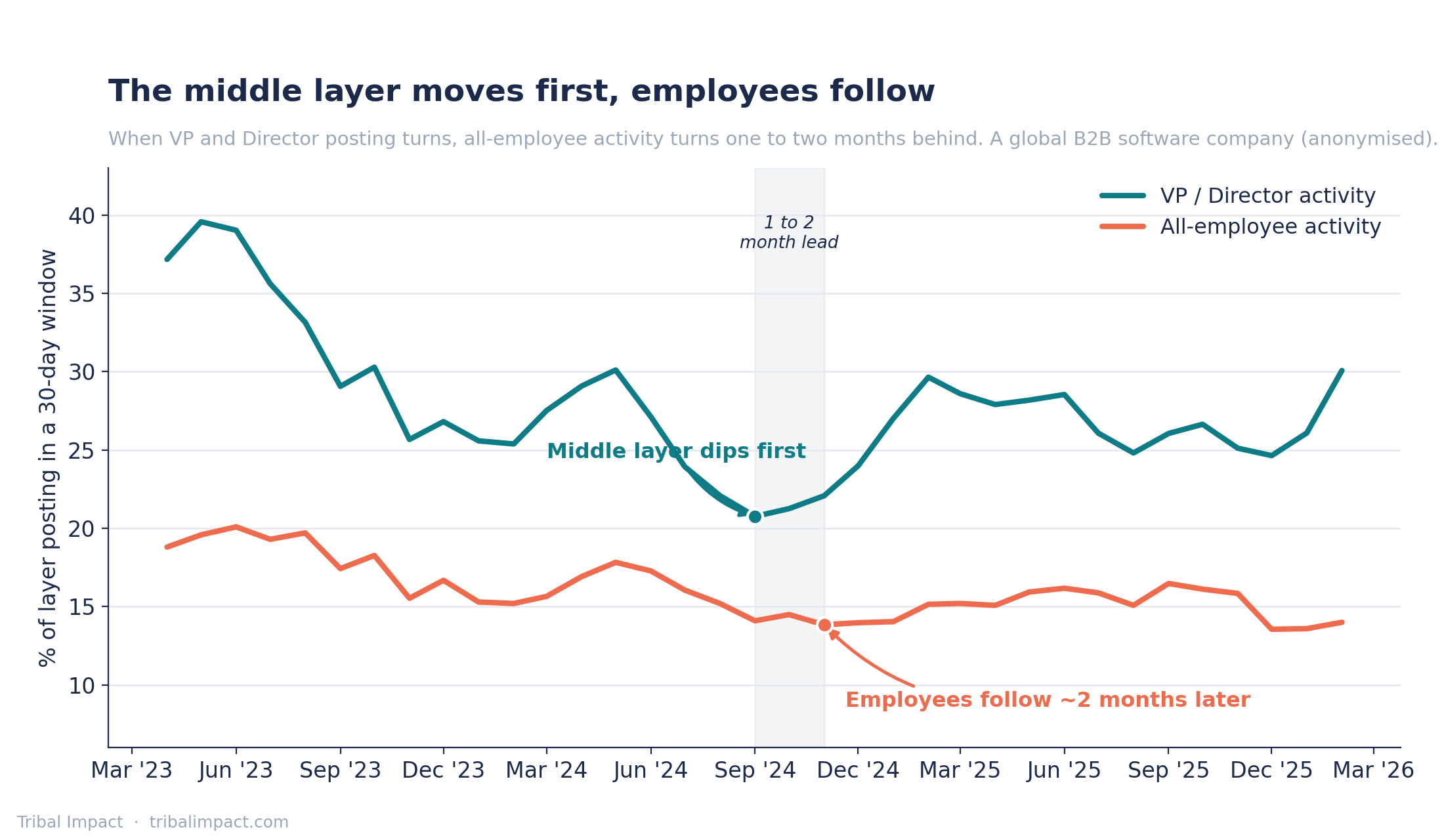
Across our dataset, employee activity follows the middle layer within one to two months. Inside client programmes, the response speed varies with context more than direction, though decline appears to take slightly longer to show than recovery.
The high-leverage intervention in your programme
The layer with the biggest multiplier in the system can be reached with one well-designed two-hour session per leader, grouped fifteen at a time. Set that against the cost of a programme plateauing at month twelve because the middle layer never believed in it, and the Leadership Multiplier Workshop may be the highest-return two hours in the entire enablement budget.
The full research behind the 4x finding, including sector benchmarks for every layer, is free to read: https://www.tribalimpact.com/thehumanedgereport. If you want to see how active your own VP and Director layer is against the 860 companies we tracked, ask. Most organisations have never looked, and the answer tends to reset the enablement plan.