.png?width=200&height=92&name=Tribal%20Logo%20Dark%20Grey%20(1).png)
More B2B organisations want their people to become visible. Executives are building market presence, experts are sharing knowledge, sellers are developing relationships, employees are contributing ideas, experience and networks.
That shift has created a growing market for employee influence services. PR agencies are supporting executive activation. Social media agencies are delivering employee training. Marketing agencies are building employee content programmes. Influencer agencies are extending their expertise into B2B.
It makes sense. These disciplines already understand communications, content, audiences, platforms and campaigns.
However, employee influence introduces another challenge:
How do you enable people across an organisation to build influence in ways that support commercial growth?
That requires a different specialism.
Key takeaways: Choosing the right partner for employee influence
- Different partners bring different capabilities to a human-led GTM strategy.
- Social media expertise helps employees understand platforms, content and how to participate effectively.
- Employee influence expertise focuses on the individual: their role, goal, confidence, motivation, capability, habits and behaviours.
- Learning how to use a platform is a skill. Building influence is a capability.
- Employee influence develops through Role -> Goal -> Habits -> Behaviours -> Impact.
- At scale, those individual contributions can become a connected Human led go-to-market (GTM) growth engine.
The expertise behind human-led GTM growth engine
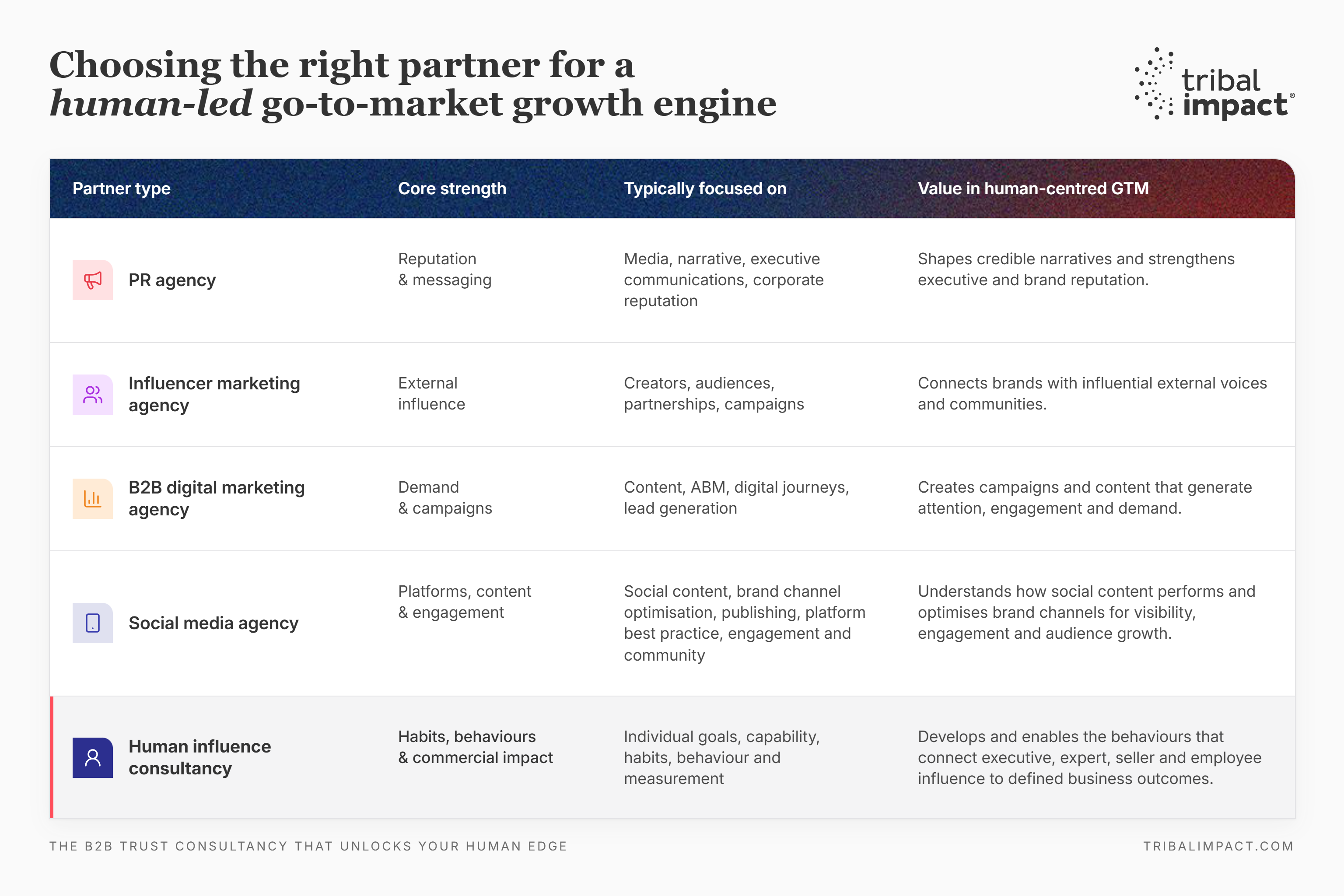
A human-led go-to-market (GTM) growth engine draws on several specialist disciplines. Each brings valuable expertise, from building brand reputation and creating demand to optimising social channels and activating external influencers. The difference lies in the capability each is designed to build.
-
PR agencies understand reputation, narrative, media and executive communications.
-
Influencer marketing agencies understand external content creators, audiences, paid partnerships and communities.
-
B2B digital marketing agencies understand campaigns, content, Account Based Marketing (ABM), demand generation and digital buyer journeys.
-
Social media agencies understand platforms, social content, brand-channel optimisation, publishing, engagement and community.
-
Employee influence consultancies specialise in connecting the people inside the organisation to commercial growth goals.
Their role is to develop and enable the habits and behaviours that help those people build influence, measured against defined business outcomes and often starts with a different set of questions.
-
What is the commercial goal that the organisation is trying to achieve?
-
Who, within the organisation, is best placed to influence that?
-
What role do those people play within the organisation?
-
What motivates them?
-
How confident are they?
-
What are they already comfortable doing online?
-
Which audiences matter?
-
Which habits could help them progress?
-
What would impact look like for them and the organisation?
Employee influence sits at the intersection of people, communication and commercial impact.
These capabilities work well together:
-
PR can develop a powerful narrative.
-
Marketing can build a campaign around it.
-
Social teams can create strong content and optimise the channels where it appears.
-
Employee influence enables the people inside the organisation to participate in ways that are relevant, sustainable and aligned to their own goals.
Social media training or employee influence enablement?
Understanding LinkedIn matters. Employees benefit from knowing how the platform works, what strong content looks like, how to optimise their profile, how to comment effectively or how to use more specialist tools such as LinkedIn Sales Navigator.
Employee influence enablement starts one step earlier: what do we need this person to achieve?
Two people can attend the same LinkedIn training, learn the same skills, then need to apply them in completely different ways.
-
A salesperson responsible for a small number of strategic accounts may need a habit of identifying and engaging new stakeholders.
-
An expert may need a regular rhythm of contributing their perspective to relevant industry conversations and forums.
-
An executive may need a sustainable approach to engaging customers, peers or employees digitally around a strategic priority.
Same platform. Different roles, goals, habits, behaviours and expectations around measures of success.
The distinction is important: learning how to use a platform is a skill. Building influence is a capability.
Why does the individual matter?
A corporate social channel belongs to an organisation. A professional profile carries an individual's name, expertise, reputation and network.
Participation is personal and entirely optional.
Confidence, motivation, culture, geography, role, seniority, experience and existing online behaviour can all influence if and how your employee participates.
Some people are natural creators. Some prefer conversations. Some have deep expertise with little confidence online. Some already have influential networks.
Edelman and LinkedIn's 2024 B2B Thought Leadership research illustrates the activation challenge:
27% of thought-leadership producers reported difficulty engaging their most senior or talented people, while 26% cited a lack of relevant skills.
The expertise may already exist inside the organisation. The opportunity is to unlock it - that requires a progression built around the individual, not the narrative, campaign, content or brand channel:
Role -> Goal -> Habit -> Behaviour -> Impact
-
Role establishes context.
-
Goal creates direction.
-
Habits create consistency.
-
Behaviour makes that influence visible.
-
Impact shows whether it is contributing to something the business values.
Employee influence goes beyond content
Publishing posts online is one way to build influence. Commenting, connecting, sharing expertise, making introductions, participating in communities and developing relationships can be equally important.
A useful comment can create a connection. That connection can develop into a conversation, then a relationship. Most importantly, consistent expertise builds brand recognition and trust.
That's because buyers value expertise.
Edelman and LinkedIn found 77% of decision-makers prefer deep subject-matter experts discussing specialised topics. Their 2025 research found 86% of hidden decision-makers want fresh perspectives that challenge their assumptions.
The opportunity for organisations is to make the expertise and experience already within their workforce more visible and connected.
From individual influence to a human led go-to-market growth engine
Individual influence becomes far more powerful when people across the organisation are aligned around the audiences, conversations and commercial priorities that matter.
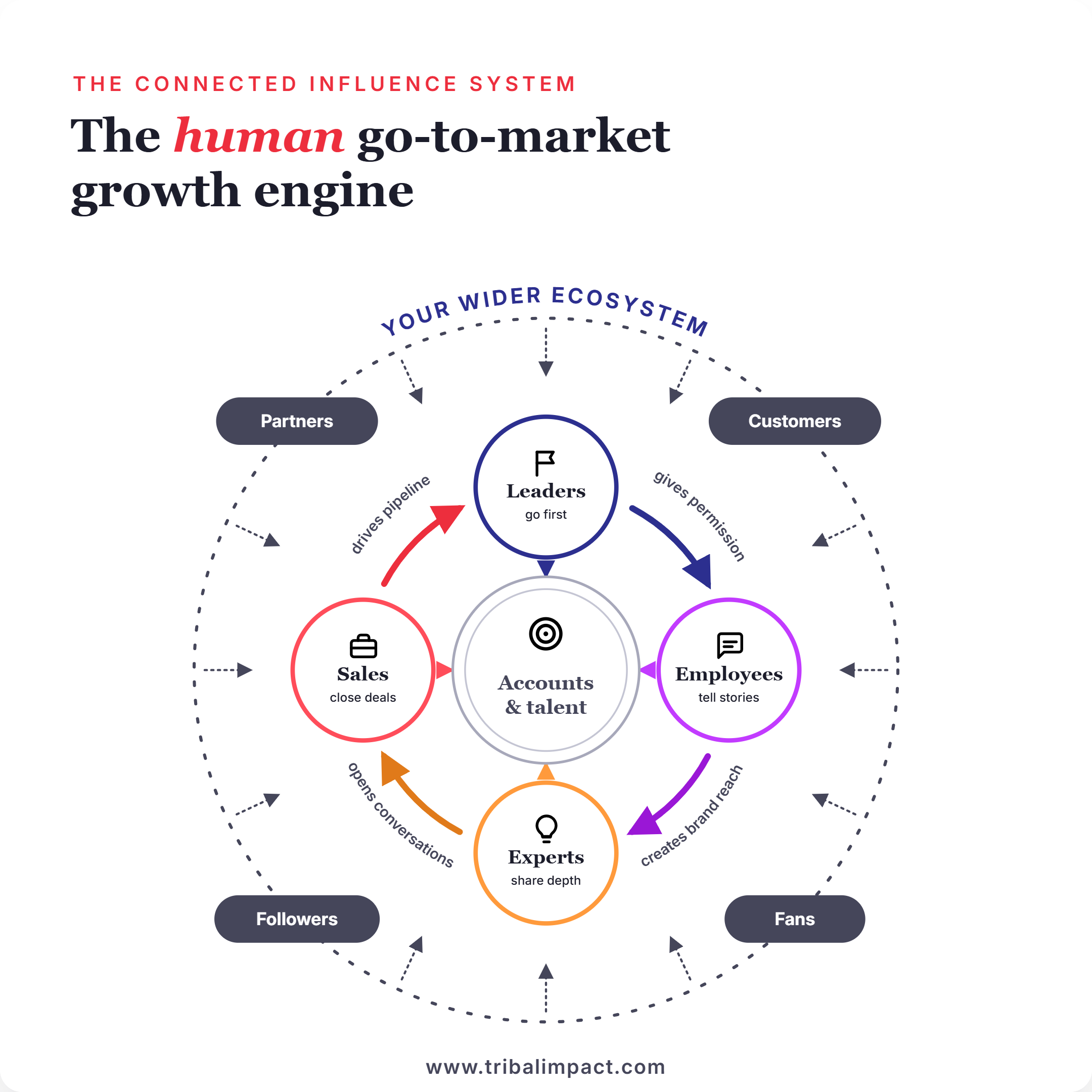
Executives can create visibility around strategic priorities. Experts can build authority around subjects customers care about. Sellers can develop relationships across strategic accounts. Employees can extend credibility through their professional networks. PR, marketing and social teams can provide the narratives, campaigns, content and channels that support them.
Employee influence provides the people capability connecting those activities.
At Tribal Impact, we call this the Human Go-to-Market Growth Engine: a connected system of influence that aligns the people inside an organisation with the audiences, conversations and commercial outcomes that matter.
Which partner do you need?
Most B2B organisations already have marketing teams and agencies build campaigns. PR specialists building narratives and managing brand reputation. Social teams managing platforms, content and channels.
Employee influence adds a new and different requirement altogether.
Enabling people.
People bring variables that a campaign brief cannot standardise. Motivation, confidence, competence, culture, language, demographics, role, experience and attitudes towards social media all influence whether someone participates, how they participate and what support will help them progress.
A perfectly designed campaign cannot make someone feel confident sharing a point of view. Great content cannot create personal motivation. A strong narrative cannot determine which habits will work for an individual or how those habits connect to their goals.
This is why employee influence requires specialist expertise in habits, behaviours and commercial impact. It starts with the goal, then the individual, then building capability around their role and goal, then measuring whether their influence is moving towards an outcome that matters - for them and the brand.
The opportunity is to add employee influence expertise to the capabilities already supporting your go-to-market strategy.
Frequently asked questions
What is a employee influence consultancy?
A employee influence consultancy helps organisations develop and measure the behaviours that enable executives, experts, sellers and employees to build visibility, credibility, relationships and trust in support of commercial goals.
What is a Human Go-to-Market Growth Engine?
A Human Go-to-Market Growth Engine is a connected system of influence that aligns executives, experts, sellers and employees with the audiences, conversations and commercial outcomes that matter to the organisation.
It connects individual employee influence with wider sales, marketing, customer growth, talent and AI visibility strategies.
How does a employee influence consultancy differ from a social media agency?
Social media agencies bring expertise in platforms, social content, brand-channel optimisation, publishing, engagement and community. Employee influence consultancies specialise in employee behaviour, capability development and measuring how individual and collective influence contributes to business outcomes.
How does employee influence differ from influencer marketing?
Influencer marketing works with external creators and influential individuals who bring established audiences and communities. Employee influence develops the visibility, credibility, expertise and relationships of people inside an organisation.
Why are role and goal important in employee influence?
Different roles contribute to growth in different ways. Sellers can strengthen strategic account relationships, experts can build authority around priority topics and executives can increase visibility among important stakeholders.
Role and goal help determine which behaviours create the greatest value for the individual and the organisation.
How should employee influence be measured?
Employee influence can be measured across four stages: Activity -> Visibility -> Trust Movement -> Business Impact.
Measures can include behaviour consistency, relevant audience growth, target-account connectivity, stakeholder engagement, topic authority, AI visibility and commercial indicators.
How do you scale employee influence?
Start with people whose roles and influence align most closely with a defined business objective. Establish a baseline, test the approach with a focused group, measure what changes and use those insights to determine the enablement and support required as the programme scales.