.png?width=200&height=92&name=Tribal%20Logo%20Dark%20Grey%20(1).png)
Originally published on LinkedIn.com
AI discoverability has shot to the top of the marketing agenda. Buyers have moved a chunk of their research into the AI engines, asking ChatGPT, Perplexity, Claude and Gemini the questions they used to type into search. A wave of tools appeared promising Generative Engine Optimisation (GEO), or Answer Engine Optimisation (AEO) - a fast track into the answers those engines give.
The temptation is to treat this like every visibility problem before it, and pay your way in. That instinct makes sense. Paid has dominated marketing for two decades, and it still does: Gartner's 2025 CMO Spend Survey puts paid media at 30.6% of marketing budgets, around 2.4% of company revenue.
Paid has always been the fastest route to visibility. Dig into the budget, work out what you can afford to compete on and promote your brand in front of more eyeballs. Paid media has always carried a catch, though: it puts you in front of millions of people without telling you how relevant that audience is.
The AI engines have changed the rules. They surface voices they judge credible, which is not something a bigger bid can secure.
Key takeaways:
- Buyers now research inside ChatGPT, Perplexity, Claude and Gemini, and you cannot bid or pay your way into the answers they get.
- AI engines reward consistency, credibility, originality, value and authority, qualities that travel with people, not logos.
- Most citations go to specialist, expert sources, and engines trust consensus, several independent voices pointing the same way.
- You cannot switch expertise on for a campaign. The signals (profile, original thinking, consistent posting, a relevant network) have to line up over time.
- Marketing can't write its way into authority on every topic. Your experts already answer buyers' questions in private, so move that knowledge into the open.
- Get it right and the same expert voices lift both your AI visibility and your SEO, building a scalable advantage competitors are still trying to buy.
Getting cited by an AI engine is not an auction you can win with a higher bid. The engines don't index the same way paid search ranks. At the same time, the economics of paid media keep tightening.
Worldwide B2B digital ad spend is climbing toward $48 billion by end of 2026, while only around 30% of CMOs feel confident they can even measure the return. Paying for AI-visibility tools, paying to pump out more content, paying for untargeted reach: every one of these is a quick fix aimed at a problem that doesn't respond to spend.
What AI engines reward
Strip back the noise and you'll find that both the LinkedIn algorithm and the AI engines reward content that demonstrates:
- Consistency
- Credibility
- Originality
- Value
- Authority
These are qualities that travel with people, not logos.
Somewhere between half and three quarters of citations go to specialist and niche sources rather than the corporate sites. The engines behave like risk minimisers, leaning on verifiable, expert, attributable content so they don't get the answer wrong. It echoes the principle Google has used for years, the one it calls E-E-A-T: Experience, expertise, authoritativeness and trustworthiness.
The engines also read consensus. When several independent sources point to the same voice on a topic, that gets treated as a signal of truth - consensus forms around people far more readily than around organisations. The 2026 Edelman Trust Barometer describes an insular trust mindset. With seven in ten people hesitant to trust anyone who differs from them, and trust flowing toward familiar individuals over institutions, it's become even more important to find and support expert voices.
Here's the thing. You can't be an 'expert' for the duration of a marketing campaign or white paper production. The signals have to line up, consistently. For example:
- Do the keywords in the experts professional profile match what they post about?
- Does the content contain original thinking not found elsewhere?
- Are they consistently sharing their expert voice?
- Are they connected to people who also engage with similar topics (the engagement that tells an engine this voice is worth following)
When organisations get this right, they don't just see their content appearing in the AI engines, they also see it in their Search Engine Optimisation (SEO) results.
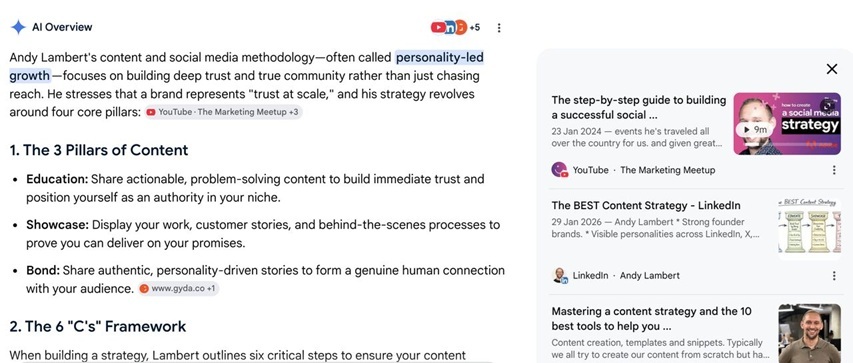
As Andy Lambert highlighted in his LinkedIn post, Google is now showing the human behind the information in their AI overview, letting searchers decide faster if it's worth their attention.
Where most companies get this wrong
Most companies meet this moment with the traditional employee advocacy mindset: treat employees as a distribution channel for brand content. That gets you visibility volume (reach and impressions - nothing wrong with that) but almost nothing the engines value.
The next mistake is cherry-picking. Once an organisation realises they need to engage expert voices, they do one of two things:
- They nominate people with large networks and to talk about topics that brand needs to drive awareness around. Unless those experts are genuinely invested in those topics, the brand will find itself in the 'chasing reach over authenticity'.
- They pick the right experts, the ones genuinely fluent in the topics that matter, then struggle to get them active. The value case never lands, so the experts stay quiet. To them, their knowledge is their worth, so sharing it feels like giving away the very thing that makes them valuable.
Why your people are the only way to scale it
Here is the part that decides it. A marketing team doesn't have the budget, nor does not have the expertise, to write its way into authority on every topic and question a buyer cares about. The people who understand those topics are the ones sitting in customer conversations every single day.
This is the link almost nobody is making. The questions your experts and sales teams answer in customer meetings are the same questions buyers are typing into the engines.
Your people are already answering them, just privately, in rooms the engine can't crawl. Move that knowledge into the open (with the confidence and support to turn a recurring customer issue into content) and you're answering the buyer's question in the place they now ask it.
That is how advocacy evolves to become influence.
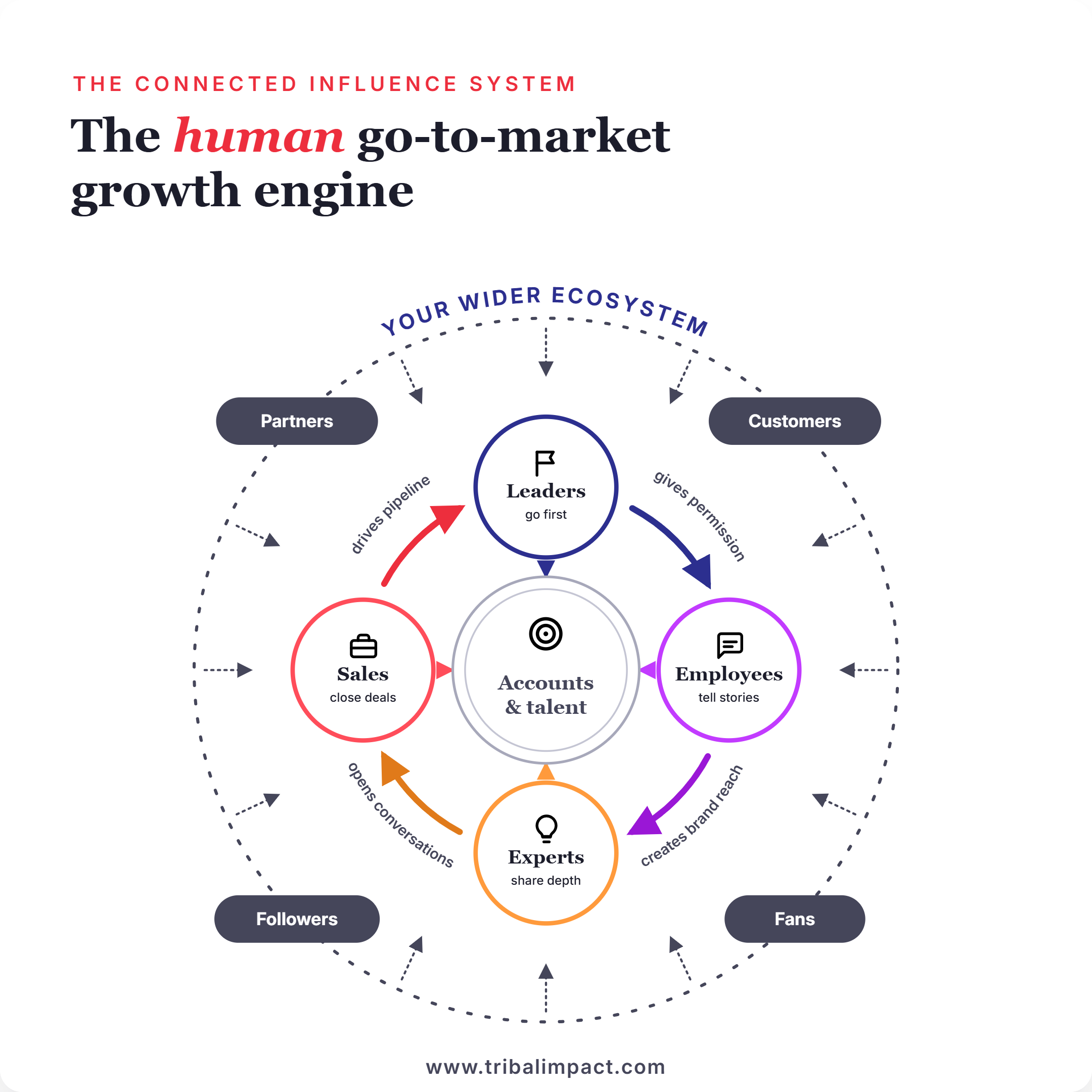
You stop scaling the volume of shares and start building a connected system of credible voices speaking to the exact issues your customers raise.
- Higher engagement follows because the content is relevant to the people it reaches.
- Stronger authority follows the engagement.
- Citations follow the authority.
What changes when you get it right
Take a real example. An executive, deeply reluctant, no interest in being visible, no belief it was worth the time.
The shift in behaviour came once the impact was made visible to them in the language they understood: who was engaging with their content and how it was supporting the company. The executive showed up more, not just as a company spokesperson but as a human.
Then it snowballed. The more this executive saw the effect, the more they posted and the more engagement came back.
The telling number was the percentage of engagement from non-employees. This executive now draws the highest non-employee engagement of anyone in the business, because they are tuned into the issues they hear in real conversations, turns that insight into content and tells those stories in a human way.
That visibility now opens doors for the sales team, with the executive connecting at a senior level into customer accounts that account executives (AEs) couldn't reach on their own.
That is a connected system of influence doing its job, the executive's presence and the sales motion pulling in the same direction.
This is where the urgency sits.
Plenty of companies are investing in influence and executive programmes already. Very few are connecting them together. The influence advantage goes to whoever connects them first and to whoever identifies their genuine expert voices earliest, because building visibility in AI engines takes time.
What this means for you
Let go of the idea that a tool or paid media will fix your AI visibility. Building visibility through your people takes longer. You're changing habits and behaviours, not buying placements. It won't land you the volume metrics that look good on dashboards. Instead, it builds a sustainable and scalable content advantage.
In a market being disrupted by AI, the strategic move is the patient one: find your real expert voices, help them show up consistently on the topics they own and let the engines find what everyone else is still trying to buy.
Frequently asked questions
Can you pay to get cited in AI search?
No. Getting cited by an AI engine is not an auction you can win with a bigger bid, because the engines do not index the way paid search ranks. They surface voices they judge credible, which spend cannot secure. Paying for visibility tools, more content or untargeted reach is a quick fix aimed at a problem that does not respond to spend.
What do AI engines reward when choosing what to cite?
Consistency, credibility, originality, value and authority. Engines behave like risk minimisers, leaning on verifiable, expert, attributable content so they do not get the answer wrong, which echoes Google's E-E-A-T principle. They also read consensus, treating several independent sources pointing to the same voice as a signal of truth.
What is the difference between GEO, AEO and SEO?
Generative Engine Optimisation (GEO) and Answer Engine Optimisation (AEO) are about earning a place in the answers AI engines generate. SEO is about ranking in traditional search results. They increasingly reward the same thing: credible, original content attached to real experts. Organisations that get it right tend to see their content surface in both.
Does employee advocacy help with AI search visibility?
Only when it moves beyond sharing brand content. Reshared corporate brand content build little authority. AI engines surface sustained expert voices whose profile, original thinking, consistency and network all line up, which is the shift from advocacy to influence.
How long does it take to build visibility in AI engines?
Longer than paid, because you are changing habits and behaviours rather than buying placements. Authority has to be built by individuals over time and cannot be switched on for a campaign. The advantage goes to whoever identifies their genuine expert voices earliest and helps them show up consistently.