40 months of LinkedIn data across 18 technology companies reveals a nine-fold gap in executive activity and why it matters for brand trust, AI discoverability and commercial growth.
Take two technology companies competing for the same enterprise deal. Similar offers, similar analyst rankings, similar marketing budgets. Now look at their leaders on LinkedIn.
We have tracked LinkedIn activity across 18 IT services and software companies for 40 months. On average monthly CXO posting rate, the most active leadership team scores 42.4%. The least active scores 4.8%. Same market, same buyers, nearly nine times the visibility.
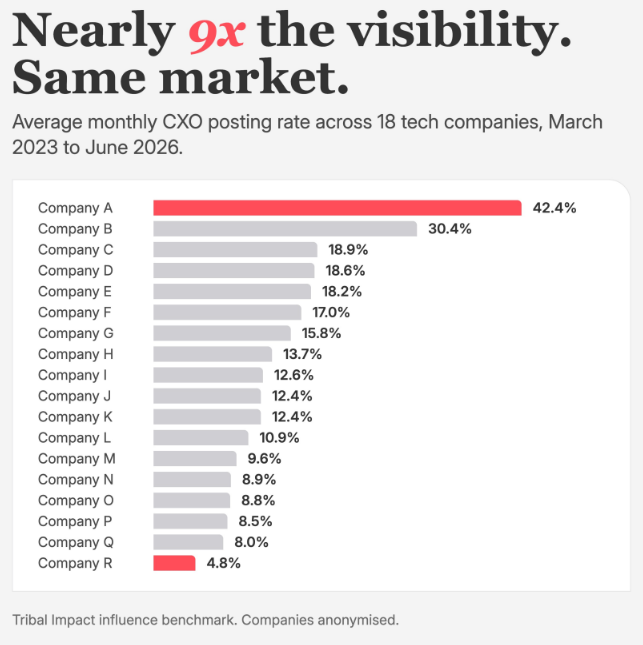
Most of the sector sits below the average, pulled up by two clear leaders. For everyone else, the question is simple: when a buyer goes looking for a point of view, whose leaders do they find?
When leaders go quiet, the organisation follows
The ranking is only half the story. The trend inside each company matters just as much.
In one global technology company we analysed, the C-suite's monthly posting rate peaked at around 18% in 2023. By mid-2026 it had fallen to 7.7%. Employee and sales activity fell right alongside it, to 7.7% and 7.2%. The only group still growing was VPs and Directors, up to 16.4%.
That pattern isn't a coincidence. Our Human Edge research found that leadership activity shapes employee activity (82%). When leaders post more, employees follow. When leaders go quiet, employees usually go quiet too, within about two months.
So executive visibility isn't a personal branding exercise. It's an organisational signal. The whole company is watching whether its leaders show up.
Why this matters more in 2027 than in 2023
By the time a B2B buyer contacts your sales team, they've already decided who they trust. 71% of hidden buyers have little or no interaction with sales (LinkedIn, 2025). They form their view from what they can find.
And what they find is increasingly chosen by AI. Forrester's 2026 State of Business Buying survey ranks generative AI and conversational search above vendor websites and sales reps as a buyer resource. Those tools favour expert voices and earned media over anything a brand says about itself.
The numbers point the same way:
- 95% of B2B buyers become more receptive to sales after strong thought leadership (Edelman and LinkedIn, 2025).
- 73% trust thought leadership over traditional marketing (Edelman and LinkedIn).
- 95% of LinkedIn content cited in AI search comes from original posts, and 48% of content cited by AI search is less than three months old.
A quiet executive is now invisible twice: once to the buyer scrolling LinkedIn, and again to the AI tool that buyer asks for a recommendation.
What the most visible leaders do differently
Posting more isn't the answer on its own. In one leadership group we mapped, posting volume tracked total engagement but had almost no link to engagement per post. More posts got more attention overall, not better attention. The leaders who stand out do five things:
-
- They show up consistently. Half the original content creators in that group posted every single month across the period we tracked. Consistency builds recognition faster than bursts of activity.
- They share original thinking. Nearly three-quarters of the group's output was original content, not reposts. That's what buyers remember, and what AI search cites.
- They own a topic, not a feed. One specialist topic in that group produced just five posts but averaged 330 engagements each. A clear point of view on a narrow subject beats general commentary on a crowded one.
- They engage, not just broadcast. Thoughtful comments and deliberate connections build networks where it counts. Executives on our Qlik programme grew CxO connections in key target accounts by 15%, and 45% of their networks are now VP level or above.
- They know influence is concentrated. In the same group, the top five people generated 45.5% of all engagement. The fastest gains come from finding the few people who already have reach and backing them properly.
Where does your organisation stand?
Most organisations can tell you how many people posted last month. Very few can tell you who has real influence, on which topics, with which audiences, or who is one step away from becoming a trusted voice.
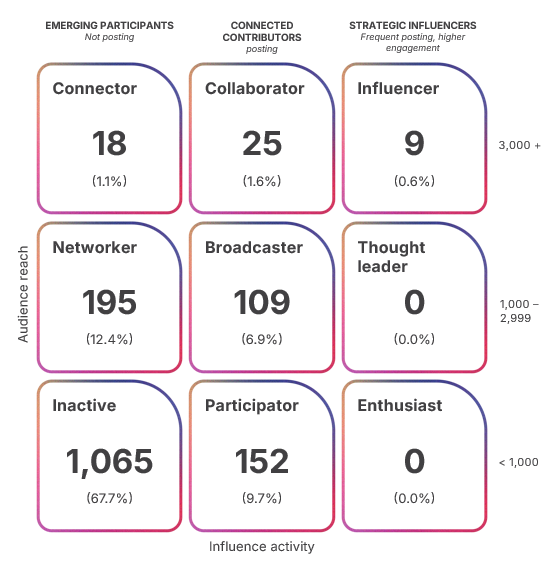
That's why we built Map to Matrix™. It places every employee on two dimensions, network reach and influence activity, across nine levels. They run from Inactive, through Participators, Networkers and Broadcasters, up to Thought Leaders and Influencers. The result is a clear picture of where influence sits today and who to activate, accelerate or recognise next.
It works. On one global manufacturer's ambassador programme, the number of ambassadors at Influencer level rose 73% in eight months, from 11 to 19. Another 22 previously inactive ambassadors started posting again.
Every programme like that starts with a Digital Activation Report: a structured, evidence-based review of your organisation's LinkedIn presence. It gives you:
- your people mapped to the Matrix, so you can see your current maturity at a glance
- your priority topics matched to the people and posts already carrying them
- a shortlist of who to invite and work with, by topic and by market
- a baseline of activity, visibility and trust metrics to measure progress against
- agreed objectives and KPIs, so investment decisions rest on data rather than instinct
Find out where you rank
We're building sector benchmarks across technology, manufacturing, life sciences and professional services. Ask for yours and we'll show you where your leadership team sits against your peers, plus a snapshot of what a full Digital Activation Report would reveal about your organisation.