.png?width=200&height=92&name=Tribal%20Logo%20Dark%20Grey%20(1).png)
Last week, I had a conversation with an employer branding lead at a global organisation and one line stayed with me. "Candidates are no longer starting on the careers site. They're starting in an AI engine."
Last week, I had a conversation with an employer branding lead at a global organisation and one line stayed with me. "Candidates are no longer starting on the careers site. They're starting in an AI engine."
On further investigation, the evidence backed this up. Research from PerceptionX showed that 96% of candidates had used AI to research employers, roles or prepare for interviews with 40% using it to discover employers they hadn’t previously considered and 72% using it to decide whether to apply to a company or not!
This means employer branding is now on the same mission as marketing - building brand visibility inside the AI engines. Albeit measuring against slightly different prompts, but facing the same challenge all the same.
Here's the part that most teams haven't clocked yet. The brand ambassador programme already built probably isn't helping gain AEO visibility.
Key takeaways: Why employer branding's AI search visibility starts on LinkedIn
- Candidates are researching employers inside AI engines before they reach your careers site, asking whether you're a good place to work and what the downsides are.
- AI engines draw heavily on LinkedIn, which means your brand ambassador programme is now part of your AI search visibility - whether you planned it that way or not.
- Most employer branding programmes are optimised for activity, meaning reposts, reshares and amplification. Activity is not the same as visibility.
- Reposts carry someone else's point of view, so they give AI engines nothing distinctive to say about your organisation (unless they're personalised in some way).
- The fix is a connected sequence: map the prompts candidates use, baseline where you rank, pick one EVP topic, brief ambassadors rather than script them and teach them to build original stories using multi-media approaches on LinkedIn.
- Measure in four stages: activity, visibility, trust movement, business impact. Most programmes report stage one.
Why advocacy numbers might be up, but AI visibility is lagging
From the programmes I've worked on, employer branding tends to run in one of two ways.
-
The first is a small, curated group of ambassadors. In a global organisation, small can still mean four or five hundred people. Whatever the size, they're a carefully selected and highly engaged group that are enthusiastic and consistently posting on LinkedIn - approx. 2-3 times a month on LinkedIn. The problem here is scale. People leave or life gets busy - activity declines and the group results are impacted.
-
The second is the 'everybody' model. Onboard the whole company, run them through a 'what it means to be a social ambassador' course, perhaps provide a content sharing tool to help them get active fast. Consistency is patchy. Some post, most don't and those that do are mostly reposting or engaging with others.
In both cases the dashboard looks reasonable. Post counts are up. Participation is up. Leader boards are gaining new members and people are building confidence.
Then you go looking for impact...after the programme is launched. This is the moment we're often engaged to help.
Activity is not the same as visibility
In my experience, this is the single reason why employee advocacy and employee ambassador programmes struggle to demonstrate value.
- Activity is showing up and doing something. Resharing a company page post. Amplifying campaign content. Sharing content via an advocacy platform. This is a great first step for many employees. It's also easy to report. It's genuinely a great first step for employees who've never posted before. The problem is treating this stage as the ultimate destination.
Stopping here limits the results a brand ambassador programme should be striving for.
- Visibility is a considered approach to building reputation and expert authority online. Content that brings original perspective that lands with a specific target audience. It's about knowing whether what you published resonated.
Visibility is less about quantity and more about quality, ensuring brand ambassadors create original content that is connected to your EVP messaging framework.
How you measure against impact - I'll discuss in a mo...
Why the urgency around AI and LinkedIn?
Original thought leadership is what LinkedIn surfaces in the feed and we know, from research, that LinkedIn content feeds the AI engines (almost as much as Reddit).
Reposts and reshares won't carry your brand into the LLMs. That creates reach (some might say noise) but essentially it'll carry the original post. Volume, in this case, doesn't. When a candidate asks an AI engine what it's like to work at your company, there's nothing of substance for the model to draw on.
Meanwhile your competitor has forty people writing about their individual (and original) experience of the culture and the model has plenty to work with.
Employer banding programmes focused on building employee influence vs just advocacy, will be the ones that build visibility.
How we approach employer brand AI visibility
Here's a framework you can start to build with your ambassadors.
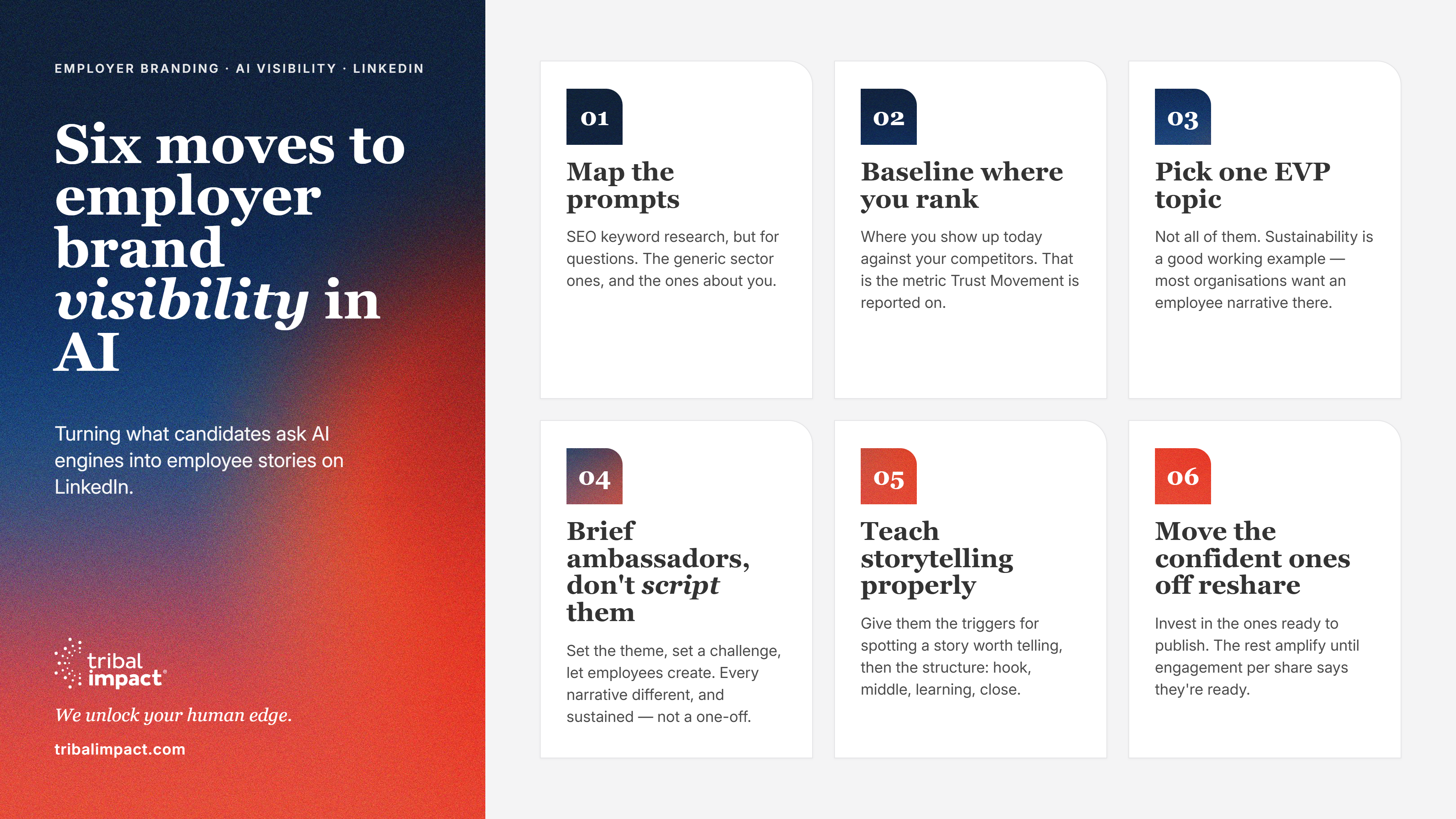
- Map the prompts. First, work out what candidates are typing into AI engines about your organisation and your sector. Treat it the way you'd treat SEO keyword research, except you're looking for questions rather than keywords. Look for generic questions e.g. which are the best companies to work for if you're a data scientist? Look for specific questions around your brand e.g. what are employees saying about working for XYZ?
- Baseline where you rank. For each of those prompts, establish where you show up today and benchmark where your competitors show up. That's your starting metric and it's the one you'll report Trust Movement against (according to our stages in the graphic above).
- Pick the EVP topic you want to prioritise. Not all of them. Sustainability is a good working example, because most organisations will want to create an employee narrative around the work they're doing in this area.
- Brief your ambassadors, don't script them. This is how the strongest B2C brands work with store staff. Global gives a brief, employees generate the creative ideas. Set the theme (e.g. sustainability) and set a challenge, then help your employees to create their narrative around it. They should all be different. This also shouldn't be a one-off challenge - consistency and sustaining the behaviour is key.
- Teach storytelling properly. Most ambassadors repost because often, they don't know what a good storytelling structure looks like. Nor do they know what makes for a good story and how to spot where story potential exists. Give them the triggers for noticing a story worth telling e.g. new role, been to an event, book review - then provide the techniques for constructing it: the hook, the middle, the learning, the close.
- Move the confident ones off reshare. Not everyone is ready to publish original content. Identify the ones who are, invest in them properly and let the rest keep amplifying company content until they're demonstrating higher engagement per share - that tells you they're tuning into what their audience cares about. They are ready for more advanced enablement.
The connecting thread is the narrative mapping exercise. You're linking the AI visibility prompts you need as an employer brand to the content your most capable ambassadors are able to create.
Connecting this framework is the missing link for many teams. Without it, you're running a training programme, not an influencer programme. Without the measurement capability, you're running it blindfolded.
How to measure AI visibility via your employee ambassadors
Here are the four stages we build for clients:
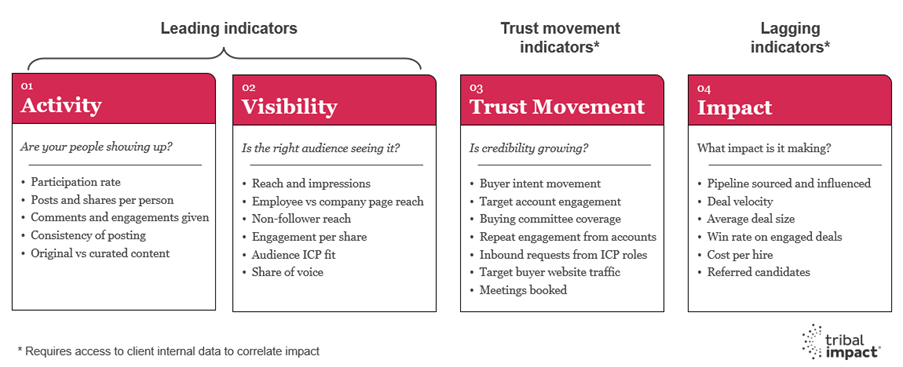
- Activity. Are your employee showing up at all on LinkedIn? Number of actively posting employees, number of shares, number of posts picked up and shared, potential reach. Useful leading indicators that tell you activity is happening.
- Visibility. Are they showing up on the topics that brand cares about (e.g. sustainability related conversation)? Are they using the language of your EVP? Is the content original or reposted/reshared? Is engagement per share increasing?
- Trust movement. Is your ranking shifting inside the AI engines for the prompts you baselined at the start? Is sentiment changing in what those engines surface about your brand?
- Business impact. Application quality, candidate self-selection, offer acceptance, cost per hire, time to hire. This is another article and too much to discuss here!
Most programmes report stage one - possibly stage two. The problem is that reporting that stops there will not defend an employee brand ambassador programme budget in the future.
Understanding the strategic goal (in this case, raising awareness in the AI engines using LinkedIn around the topic of sustainability) is where Trust Movement is measured and correlated back to employee ambassador activity.
The AI opportunity for employer branding
Employer branding has something marketing often doesn't. Genuine, first-hand, authentic stories about what the organisation is like. That's exactly the material AI engines love and reward because those stories are unique to the person telling them. They can't be found anywhere else.
The work is around redirecting a programme that's been optimised for volume towards one that's optimised for results the board cares about. Same people. Connected messaging strategy. Measurement around impact.
I'm noticing that both marketing and employer branding teams are trying to solve the same issue - just from a slightly different lens. The teams that move first will own the answer candidates get for years to come.
Frequently asked questions
Should we stop resharing altogether?
No. Resharing is a reasonable entry point and it keeps less confident people involved in your program. Just stop counting it as visibility - it's activity.
How many ambassadors do we need creating original content?
Fewer than you'd think. A committed group of twenty publishing genuine perspective will outperform four hundred resharing/reposting content.
How long before AI visibility shifts?
Expect months, not weeks although we've seen results shifting within weeks - some posts appear in days! Which is why a baseline matters. Without it you have no way of proving the movement when it comes.
If you're interested to learn more about how to measure the impact of this approach and indeed build an enablement sprint around a cohort of expert employees who are ready (we can identify who they are) get in touch as we deliver cohort enablement sprints for employees digitally mature enough for this kind of activation.