Employee advocacy tools can help organisations make relevant content accessible, support participation and coordinate sharing but access to a platform does not, by itself, build employee influence. As organisations review their investment for 2027, the more useful question is whether the technology supports the people, behaviours and business objectives the programme was designed to serve.
For years, employee advocacy programmes have focused on extending the reach of corporate content. That remains a valid objective, but it is not the same as developing trusted voices who can build relationships with customers, partners and prospective employees. A programme measured primarily by shares and impressions can overlook whether employees are developing their expertise, reaching relevant audiences or contributing to wider organisational outcomes.
This article explores where advocacy platforms still add value, how their role should evolve as employees develop, and what organisations should assess before renewing their investment.
Key takeaways: Do you need an employee advocacy tool in 2027?
- Start with the programme objective. Technology should support a defined employee influence and advocacy strategy, rather than determine it.
- Allocate licences intentionally. Participation, employee readiness and role-specific needs are more useful guides than the ambition to give everyone access.
- Support progression beyond sharing. Employees should have opportunities to add their own perspectives, create original content and contribute expertise back into the programme.
- Match enablement to maturity. Employees need different support according to their confidence, activity, network and objectives.
- Measure contribution, not activity alone. Connect participation and visibility with evidence of trust movement and wider business impact, without claiming sole attribution.
Why should employee advocacy move beyond brand awareness?
Brand awareness remains a legitimate part of employee advocacy. Sharing relevant corporate content can introduce an organisation’s work to wider networks and give employees a practical starting point for participation. The limitation arises when distribution becomes the programme’s primary purpose.
There is a substantial network opportunity: LinkedIn’s B2B Institute reports that employees’ personal networks collectively reach 12 times a company’s own follower base, citing LinkedIn’s 2025 guide to working with B2B creators. This is a network-reach comparison, not a guarantee of post performance or a measure of the uplift an advocacy tool delivers. (LinkedIn B2B Institute, 2026.)
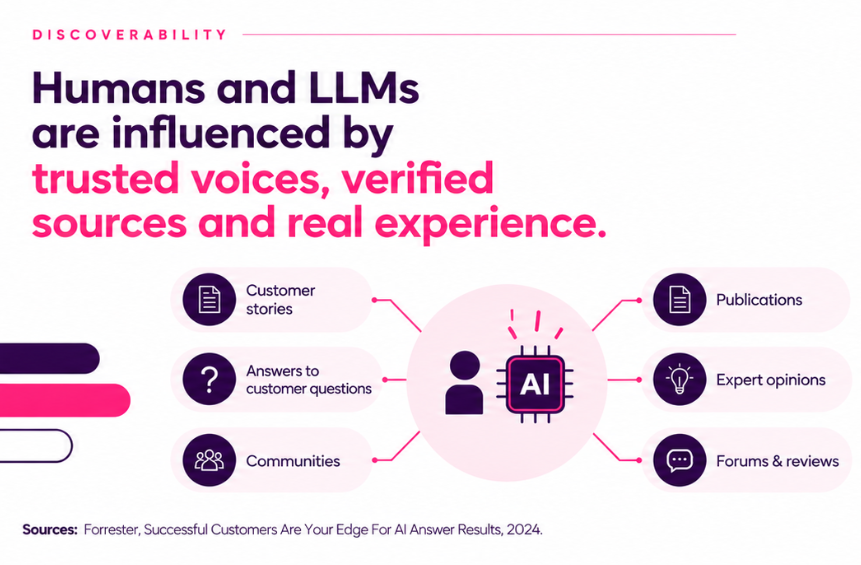
Trusted influence requires more than repeated exposure to a brand message. It involves people demonstrating expertise, contributing useful perspectives and developing relationships with audiences that matter to the business. The distinction is between measuring how far content travels and understanding whether the right people are becoming known for something relevant.
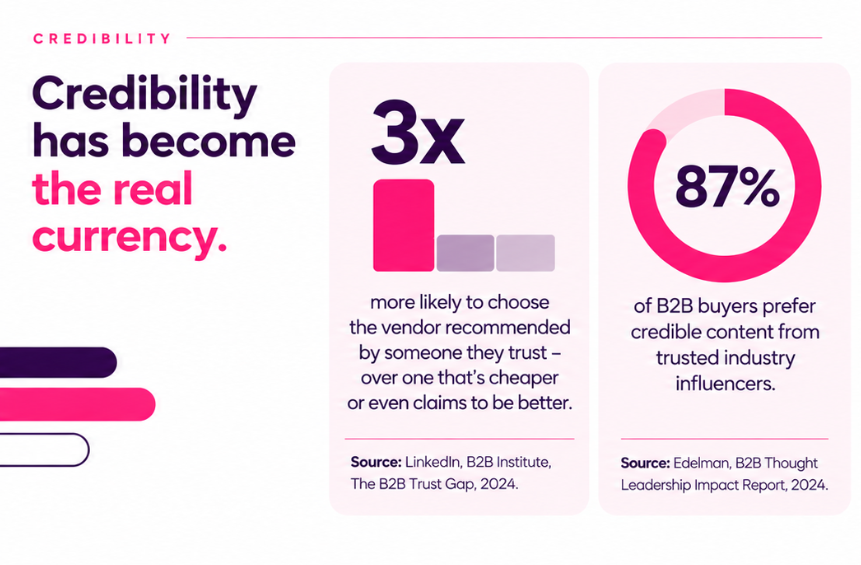
The commercial importance of credibility extends beyond employee advocacy. In its 2026 research summary, LinkedIn reports that B2B buyers are 3x more likely to choose a recommended vendor over a cheaper one, citing the 2025 LinkedIn-Bain & Company Principles of Buyability research.
This finding concerns vendor recommendations, not employee posts specifically; it provides context for prioritising trusted relationships rather than treating reach as the final outcome. LinkedIn B2B Institute, 2026.
Programme design should therefore begin with the intended outcome:
-
A salesperson may need to strengthen relationships within target accounts.
-
An executive may focus on credibility around a strategic issue, while a technical expert helps buyers understand a complex challenge.
-
An employee contributing to employer branding brings a different perspective again: an informed view of working life inside the organisation.
These objectives can sit within one coordinated programme, but they require different content, networks and support. A common platform can help organise participation; it cannot replace those decisions.
Do all employees need an advocacy platform licence?
Licence allocation should reflect how employees will use the platform and what support they need. Expanding access without understanding readiness risks treating a technology purchase as a participation strategy.
-
Some employees already publish original content and maintain relevant professional networks without using an advocacy platform.
-
Others want to participate but need help finding appropriate content or understanding what they can say.
-
Some will choose not to develop a public professional presence, and participation should remain voluntary.
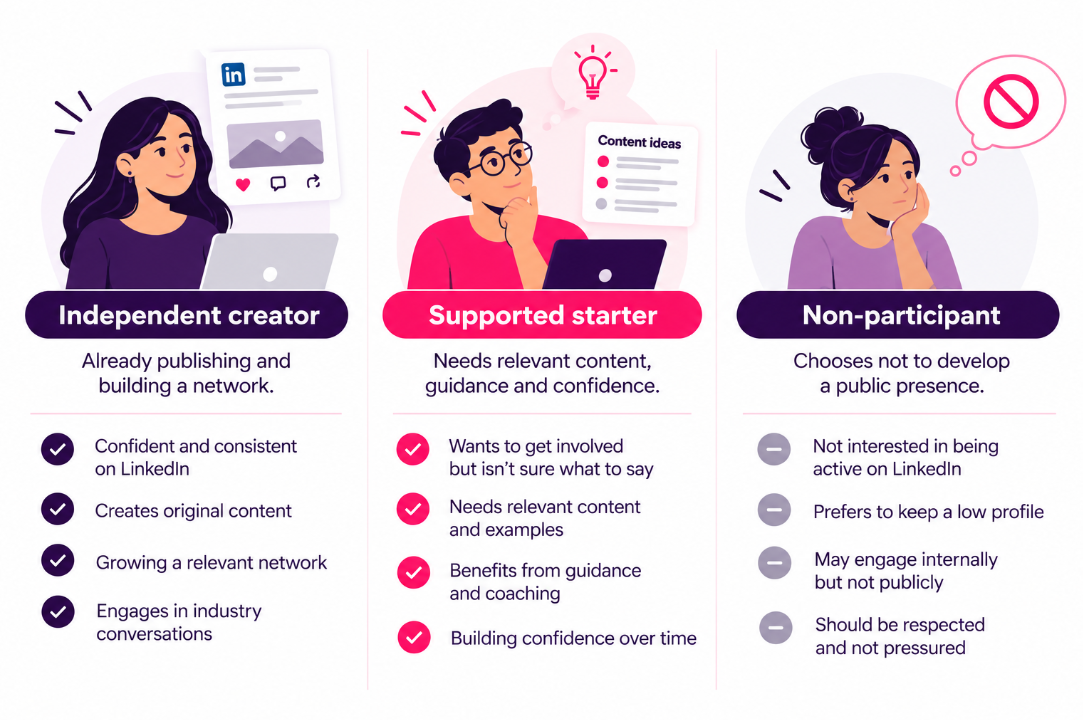
A useful review distinguishes between employees who actively benefit from the platform, those who could benefit with appropriate support, and those whose needs are better served elsewhere. Low usage should prompt a diagnosis rather than an automatic decision to remove access: the barrier may be confidence, content relevance or a lack of clarity about the programme’s purpose.
The investment question is not how many employees can be enrolled. It is where platform access, combined with enablement, can support meaningful participation.
Where do employee advocacy tools still add value?
Advocacy platforms can provide a structured starting point for employees who are uncertain about becoming visible online. Access to relevant, approved content reduces the pressure to create every post from a blank page and gives employees material they can use to begin participating.
This can be particularly helpful where employees are concerned about saying the wrong thing. In regulated environments, clear content guidance and approval processes can sit alongside training that explains the boundaries of appropriate participation. The platform supports that framework; it does not replace an understanding of the rules.
The risk is allowing this starting point to become a permanent endpoint. If employees are taught only how to share corporate posts, and success is defined only by the number of shares, the programme provides little encouragement to develop their own voice.
Sharing remains useful when the content is relevant. Its value should sit within a broader development path that helps employees contribute their own knowledge, not simply distribute messages produced elsewhere.
It's important to note that employee advocacy tools have now evolved to become "employee monitoring tools" - where the employee authenticates their account on the platform and effectively gives the tool permission to track their activity (whether posting via the tool or natively on the platform).
How can employees progress from sharing to contributing?
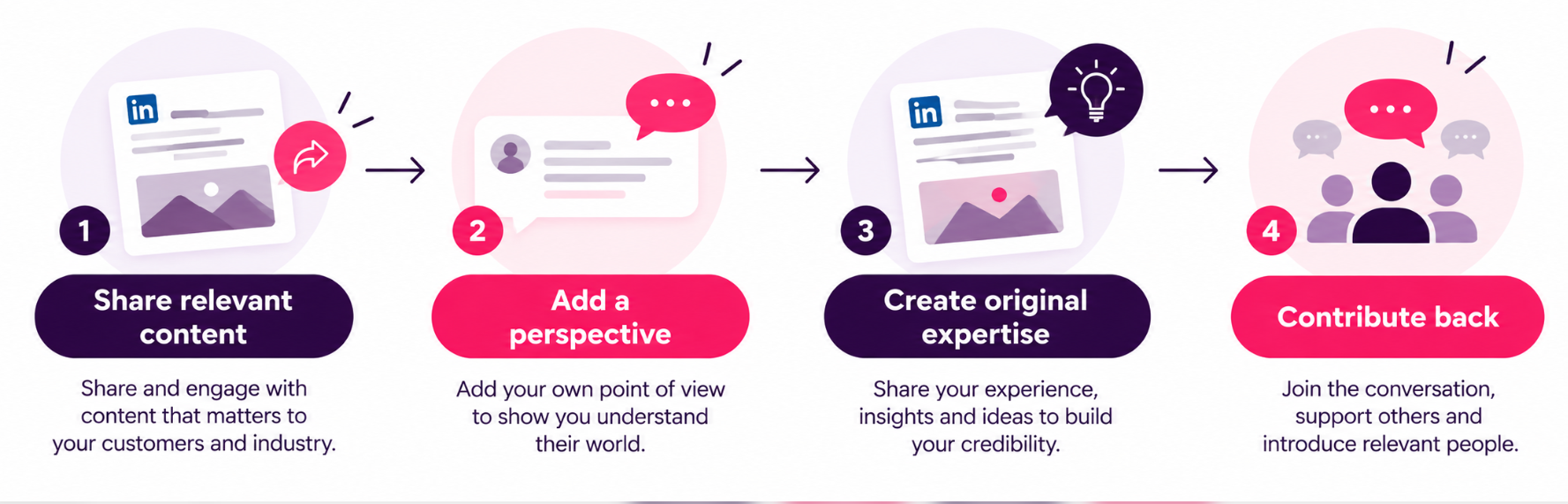
As employees gain confidence, their relationship with the platform can evolve. They may begin by sharing approved content, then add commentary explaining why it matters to their audience. With further support, they can develop original posts based on customer questions, project experience or professional observations.
This progression should preserve individual judgement and personality. The aim is not to turn every employee into a high-volume content creator, but to help people contribute expertise in a way that suits their role and interests.
Original employee content can also become a resource for the wider organisation. Where the platform supports it and appropriate permissions are in place, colleagues can discover and share that expertise, adding their own relevant perspectives rather than reproducing identical messages.
Our discussion with LinkedIn’s Purna Virji explores how employee advocacy can elevate a content strategy, including how employees can bring different perspectives to a shared company theme.
In programmes we have supported, we have observed employees responding positively to content created by colleagues. This is a practitioner observation, not a universal performance benchmark. It highlights an opportunity to make peer expertise more visible within the programme, alongside appropriate brand content.
The platform’s role then extends beyond corporate distribution: it helps useful employee knowledge travel further.
Why does employee influence maturity matter?
Employees do not begin with the same confidence, habits or professional networks. A single onboarding session and a common content library cannot address every starting point.
At Tribal Impact, our Influence Maturity Matrix maps employees according to their social media activity and network strength. This helps identify where people are starting and what support is appropriate, rather than assuming that everyone needs the same training or technology.
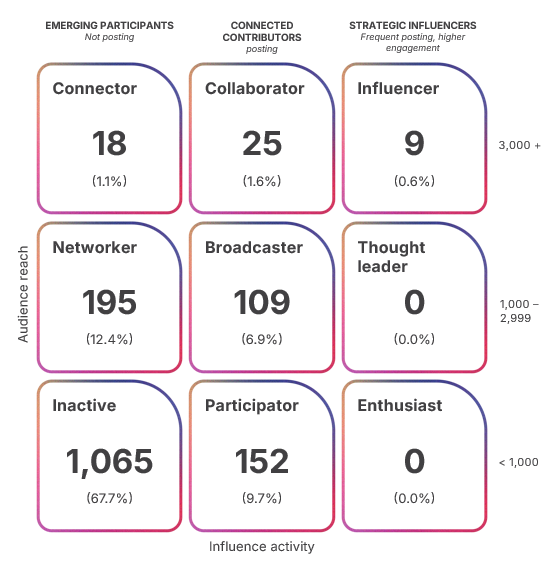
For employees beginning to participate, support may centre on clear guidance, relevant content and manageable routines. Those already sharing may benefit from coaching on adding their own perspectives, developing relevant connections and joining industry conversations. More experienced contributors may need support with topic focus, thought leadership and alignment with strategic business priorities.
Henkel’s approach to global employee advocacy provides a practical example: strategy, ongoing enablement and a content platform work together, with support tailored to employees’ roles, confidence and social maturity.
Progression does not require everyone to follow an identical path. Occasional, relevant participation and sustained expert visibility can both have a place. What matters is that support reflects the person’s role, objectives and willingness to participate.
How should organisations measure employee advocacy ROI in 2027?
A platform review needs to consider more than usage. Shares, clicks and impressions help describe activity and visibility, but they do not establish whether employees are developing influence or contributing to business outcomes.
Tribal Impact approaches measurement through four connected layers:
1. Activity
Assess participation and behaviour. Are employees developing consistent habits, sharing relevant content and beginning to contribute their own expertise? This shows whether the programme is becoming embedded in everyday work.
2. Visibility
Examine whether employee expertise is reaching relevant audiences. Reach and engagement provide useful signals, but audience relevance matters more than volume alone.
3. Trust Movement
Look for evidence that relationships are developing: relevant new connections, engagement from target accounts, inbound questions and opportunities for meaningful conversations. These signals require a broader view than platform sharing data alone.
4. Business Impact
Assess how employee influence contributes to the outcomes the programme was designed to support. Depending on the objective, these may include pipeline development, stronger account relationships or recruitment outcomes.
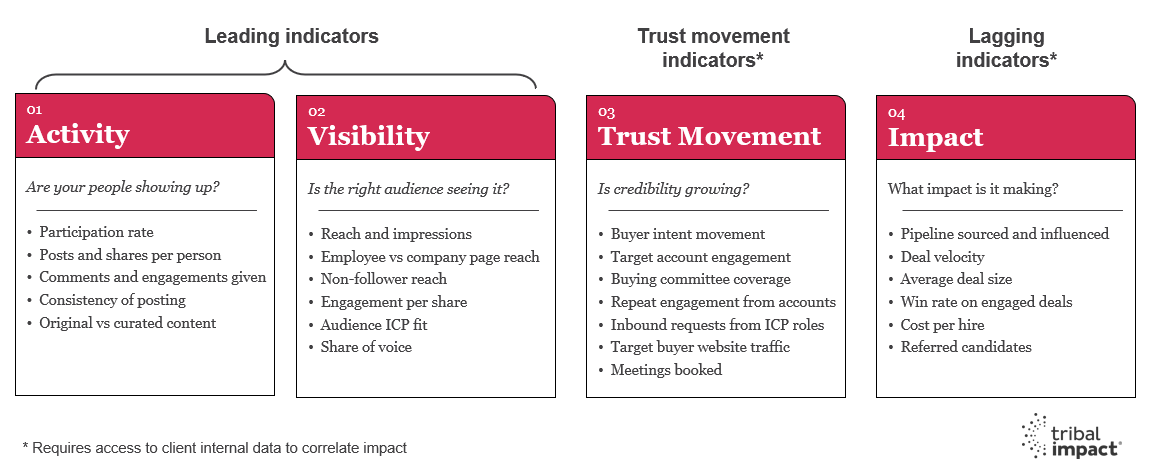
These layers should be interpreted together and over time. A LinkedIn post rarely explains a commercial result on its own: sales activity, product, pricing and market conditions also matter. The aim is to identify credible contribution and correlation, not assign sole responsibility to marketing or employee advocacy.
Our guide to measuring the success of an employee advocacy programme explores why departmental objectives and qualitative evidence should sit alongside quantitative reporting.
Programme development also deserves attention. More employees contributing original expertise, a broader range of active voices and sustained participation can indicate a stronger foundation, even before longer-term business effects are visible.
What should you review before renewing an advocacy platform?
A renewal is an opportunity to revisit the programme’s purpose, not simply continue an existing contract. Five questions can help structure that assessment:
- What outcomes should the programme support? Clarify whether the priority is brand awareness, pipeline influence, executive visibility, talent attraction or a defined combination.
- Who is already active and influential? Look beyond platform users to identify employees developing relevant relationships and expertise elsewhere.
- Who genuinely benefits from a licence? Review usage alongside employee readiness, role and support needs, rather than treating access as evidence of value.
- Are employees developing their own voices? Examine whether the programme supports original perspectives and peer expertise, as well as appropriate corporate sharing.
- What evidence connects participation with wider outcomes? Assess activity, visibility, trust movement and business impact without overstating attribution.
The answers may support retaining the platform, changing licence allocation or investing more in enablement. The decision should follow the programme’s needs rather than assume that more technology will resolve a participation or strategy gap.
In conclusion: the tool should support the influence strategy
An employee advocacy tool can still have an important role in 2027. It can help employees find relevant content, begin participating and make their colleagues’ expertise more visible. Its value depends on how well it supports the wider programme.
The priority is to build a system that develops people: clear objectives, voluntary participation, role-specific enablement, ongoing coaching and measurement that connects behaviour with business contribution. Technology should make that system easier to operate, not become a substitute for it.
If you are reviewing your employee influence and advocacy programme for 2027, get in touch with Tribal Impact to explore where your platform adds value and what your people need next.
FAQs about employee advocacy tools in 2027
Do you need a tool to run an employee advocacy programme?
Not every programme requires a dedicated platform. The decision depends on the coordination, content access and reporting support your employees need. Start with the programme objectives and operating requirements, then assess whether technology helps deliver them.
Should every employee have an advocacy platform licence?
No. Licence allocation should reflect employee needs, willingness to participate and the value they receive from the platform. Review low usage in context before deciding whether the answer is better support, different content or a change in access.
How can an advocacy platform support original employee content?
Where its capabilities allow, a platform can help colleagues discover and share employee-created content as well as approved brand material. Coaching and clear contribution processes are still needed to help employees develop their own perspectives.
What should organisations measure beyond shares and impressions?
Look at relevant audience visibility, relationship development, inbound conversations and contribution to defined business outcomes. Combine these with participation trends and evidence of employee development rather than relying on a single metric.